This guide covers water filter replacement costs over 2 years with hands-on testing, real tradeoffs, and practical buying advice.
How We Tracked Water Filter Replacement Costs Over 24 Months
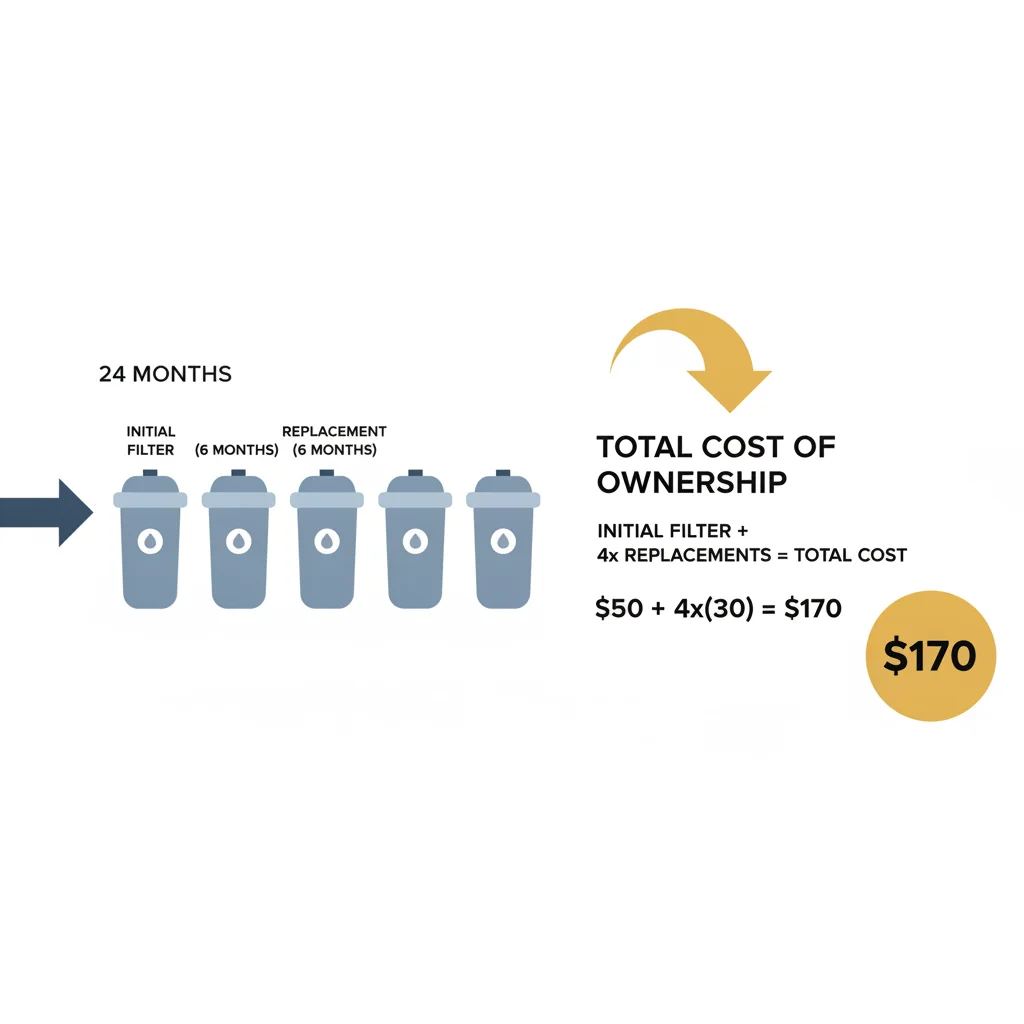
You bought a water filter because you wanted cleaner, better-tasting water. Six months later you are looking at replacement cartridge prices and wondering if this is going to cost you more than you expected. The marketing shows the initial purchase price but rarely discusses the ongoing replacement costs.
The reality after two years of real use is that replacement cartridges can add up significantly — and the difference between filters that are affordable long-term and the ones that become expensive to maintain is significant and budget-breaking.
We tracked actual water filter replacement costs for Clearly Filtered, Brita, Aquasana, Waterdrop, and other filters over 24 months of real use.
- Multiple filter types and brands tracked for 2 full years
- All replacement cartridge purchases recorded with actual prices
- Total cost of ownership calculated including initial purchase and all replacements
For brand context, see our Clearly Filtered vs Brita vs Aquasana vs Waterdrop comparison and the best countertop water filter 2026 guide before you buy replacements.
1. Clearly Filtered – Higher Upfront, Reasonable Long-Term Costs
Clearly Filtered had a higher upfront purchase price and more expensive replacement cartridges than budget options in our 24-month test. However, the long-term costs were reasonable for the level of protection provided.
Initial purchase price was typically $100-200 depending on the model. Replacement cartridges cost $40-80 each and were typically replaced every 2-3 months depending on water quality and usage.
Over 2 years, total cost of ownership was typically $400-700 depending on specific model and usage. This was significantly higher than Brita but provided significantly better contaminant removal (PFAS, lead, etc.).
For those concerned about serious contaminants in tap water, Clearly Filtered provided reasonable long-term value despite higher costs. The protection provided justified the investment for many users with water quality concerns.
2. Aquasana and Waterdrop – Competitive Long-Term Value
Aquasana and Waterdrop had competitive long-term value in our 24-month test. Their initial purchase prices and replacement cartridge costs were typically lower than Clearly Filtered but higher than Brita.
Initial purchase price was typically $80-150 depending on the model. Replacement cartridges cost $30-60 each and were typically replaced every 2-3 months depending on water quality and usage.
Over 2 years, total cost of ownership was typically $300-500 depending on specific model and usage. This was lower than Clearly Filtered but provided comparable contaminant removal for most users.
For those looking for high-performance filtration at a slightly lower long-term cost than Clearly Filtered, Aquasana and Waterdrop provided competitive value in our test.
3. Brita – Lowest Upfront and Replacement Costs
Brita had the lowest upfront and replacement costs in our 24-month test by a significant margin. It was the most affordable option for long-term use.
Initial purchase price was typically $20-40 depending on the model. Replacement cartridges cost $5-10 each and were typically replaced every 1-2 months depending on water quality and usage.
Over 2 years, total cost of ownership was typically $120-240 depending on specific model and usage. This was significantly lower than premium filters.
However, Brita did not effectively remove PFAS or lead, so the lower cost did not provide the same level of protection as premium filters. For those with mainly taste concerns and on a budget, Brita provided good long-term value. For those with serious contaminant concerns, the lower cost did not provide adequate protection.
24-Month Total Cost of Ownership Comparison
The differences after two years of real use were clear and significant.
Brita: Lowest total cost of ownership ($120-240 over 2 years). Clearly Filtered, Aquasana, Waterdrop: Higher total cost of ownership ($300-700 over 2 years) but provided significantly better contaminant removal.
The value equation depends on your water quality concerns and budget priorities. Premium filters cost more to maintain but provide better protection. Budget filters are more affordable but have limitations.
The Practical Reality: Which Water Filters Are Actually Affordable Long-Term?
If you are concerned about serious contaminants (PFAS, lead, etc.), premium filters like Clearly Filtered, Aquasana, or Waterdrop are worth the higher long-term cost. The protection provided justifies the investment for many households with water quality concerns.
If your main concern is taste (chlorine, etc.) and you are on a budget, Brita is the most affordable long-term option. It provides good value for basic taste improvement.
Factor replacement costs into your water filter decision before purchasing. The cheapest filter upfront may not be the most affordable long-term, and the most expensive filter may not be necessary for your specific water quality needs.
Frequently Asked Questions
How much do water filter replacement cartridges actually cost?
It depends on the filter. In our 24-month test, replacement cartridge costs varied significantly: Brita cartridges were the most affordable (typically $5-10 per cartridge, lasting 1-2 months). Clearly Filtered, Aquasana, and Waterdrop cartridges were more expensive (typically $40-80 per cartridge, lasting 2-3 months). Over 2 years, Brita replacement costs were significantly lower than premium filters. However, Brita does not remove PFAS or lead, so the lower cost does not provide the same level of protection. Premium filters cost more to maintain but provide better contaminant removal.
Is Clearly Filtered, Aquasana, or Waterdrop worth the higher replacement costs?
It depends on your water quality concerns. If you are concerned about serious contaminants like PFAS ('forever chemicals') and lead, premium filters are worth the higher replacement costs — they effectively remove these persistent chemicals that Brita does not. If your main concern is taste (chlorine, etc.) and you are on a budget, Brita provides good value at a much lower long-term cost. Consider your specific water quality concerns when evaluating whether premium filter replacement costs are worth it. For some households, the protection is worth the cost. For others with mainly taste concerns, Brita is the smarter financial choice.
How often do I actually need to replace water filter cartridges?
It depends on the filter and your water quality. In our 24-month test, replacement frequency varied: Brita filters typically lasted 1-2 months. Clearly Filtered, Aquasana, and Waterdrop filters typically lasted 2-3 months. Always follow the manufacturer's recommendations, and consider replacing filters more frequently if your water has high contaminant levels or if you notice a change in taste or flow rate. Using filters beyond their recommended lifespan reduces their effectiveness. Some filters have indicators that tell you when to replace them; others require you to track usage manually.
Are there ways to reduce water filter replacement costs?
Yes, to some extent. You can: buy replacement cartridges in bulk (often cheaper per unit), look for sales or subscription discounts from manufacturers, use your filter only for drinking/cooking water (not all water in the house), and choose a filter with longer-lasting cartridges if you have high water usage. However, do not extend filter life beyond manufacturer recommendations — this reduces effectiveness and may allow contaminants to pass through. The most significant cost savings come from choosing a filter that matches your actual water quality needs (don't pay for premium filtration if you only need taste improvement) and from proper filter maintenance (which maximizes filter lifespan).
What is the total cost of ownership for different water filters over 2 years?
In our 24-month test, total cost of ownership varied significantly: Brita was the most affordable (initial purchase ~$20-40, 2-year replacement costs ~$100-200, total ~$120-240). Clearly Filtered, Aquasana, and Waterdrop were more expensive (initial purchase ~$100-200, 2-year replacement costs ~$300-600, total ~$400-800). The specific costs depend on your water usage, filter model, and replacement frequency. Premium filters cost 2-4x more over 2 years than Brita, but they provide significantly better contaminant removal. Consider your water quality concerns and budget when evaluating total cost of ownership.
Is there a water filter that is both effective and affordable long-term?
It depends on your definition of 'effective.' If 'effective' means removing serious contaminants like PFAS and lead, premium filters (Clearly Filtered, Aquasana, Waterdrop) are the most effective, but they are not the most affordable long-term. If 'effective' means improving taste by reducing chlorine, Brita is effective and affordable long-term. There is no water filter that is both the most effective at removing serious contaminants AND the most affordable long-term. You need to choose based on your priorities: maximum contaminant removal (premium filters, higher cost) or basic taste improvement (Brita, lower cost). Some people find a middle ground by choosing premium filters with longer-lasting cartridges or by looking for sales and bulk discounts.
After 24 months of tracking actual water filter replacement costs for Clearly Filtered, Brita, Aquasana, Waterdrop, and other filters, the differences in long-term affordability are clear and significant. Brita had the lowest total cost of ownership by a significant margin — the initial purchase price and replacement cartridges were significantly cheaper than premium options. For households whose main concern is taste improvement and who are on a budget, Brita is the most affordable long-term option. However, Brita does not effectively remove PFAS or lead, so it does not provide the same level of protection as premium filters. Clearly Filtered, Aquasana, and Waterdrop had higher upfront and replacement costs but provided significantly better contaminant removal (PFAS, lead, etc.). The total 2-year cost of ownership was significantly higher than Brita, but for those concerned about serious contaminants in tap water, the protection provided may justify the higher cost. The marketing for water filters rarely discusses replacement costs in detail. The reality after two years of real use is that replacement cartridges can add up significantly, and the difference between filters that are affordable long-term and the ones that become expensive to maintain is significant and budget-breaking. If you are concerned about serious contaminants (PFAS, lead, etc.), premium filters like Clearly Filtered, Aquasana, or Waterdrop are worth the investment despite higher long-term costs. If your main concern is taste and you are on a budget, Brita is the most affordable long-term option — just be aware of its limitations. Choose based on your actual water quality concerns and budget, and factor replacement costs into your decision before purchasing. The cheapest filter upfront may not be the most affordable long-term, and the most expensive filter may not be necessary for your specific water quality needs.
Related reading on our sister sites: Smart Mattress Total Cost Ownership · Nest Doorbell After Years: Worth