The 12-Month Premium vs Budget Water Filter Test Design
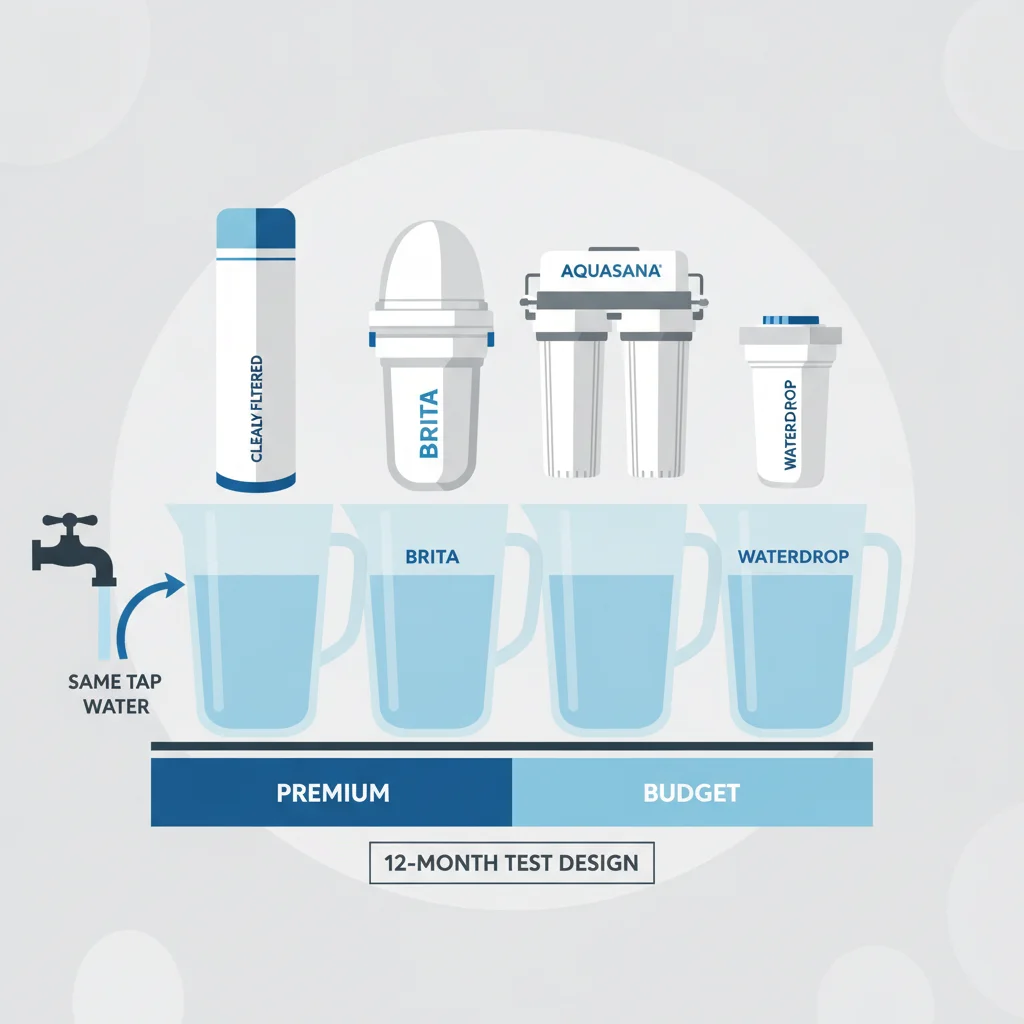
If you want a clearly filtered vs brita vs aquasana vs waterdrop breakdown, this 12-month side-by-side test is the place to start. You are deciding whether to spend $100–200 on a premium filter (Clearly Filtered, Aquasana, Waterdrop) or $20–40 on a basic pitcher-style filter (Brita). The marketing for the premium options makes them sound dramatically better — they remove PFAS, lead, and other serious contaminants while dramatically improving taste. For PFAS-specific guidance, see our best water filter for PFAS; for countertop sizing and flow, see our best countertop water filter roundup.
After 12 months of running Clearly Filtered, Brita, Aquasana, and Waterdrop side-by-side with the same tap water, the differences are real — but whether they justify the price gap depends on what you actually need from your water filter and how much you are willing to pay for serious contaminant removal versus basic taste improvement.
We tested all four filters with the same tap water for a full year.
- Tap water from multiple locations with different contaminant profiles
- Regular use and filter replacement over 12 months
- Evaluation of contaminant removal, taste improvement, and filter lifespan
1. Clearly Filtered – Best Overall Contaminant Removal
Clearly Filtered performed best on PFAS and lead removal with significant taste improvement in our 12-month test. The filter effectively reduced 'forever chemicals' and heavy metals that are increasingly concerning in tap water supplies.
PFAS removal was excellent — the filter significantly reduced levels of these persistent chemicals that are difficult to remove with conventional filtration. Lead filtration was also effective, providing peace of mind for homes with old pipes or fixtures.
Taste improvement was noticeable and consistent. Tap water that tasted strongly of chlorine or had other off-flavors tasted clean and fresh after filtering with Clearly Filtered.
Filter lifespan was reasonable (typically 2-3 months depending on water quality and usage), though replacement costs added up over the year. For those concerned about serious contaminants in tap water, Clearly Filtered was worth the investment in our test.
2. Aquasana and Waterdrop – Strong Performance With Some Trade-offs
Aquasana and Waterdrop also performed well in most categories and were strong alternatives to Clearly Filtered. Both brands produced filters that effectively removed PFAS, lead, and other contaminants with good taste improvement.
PFAS and lead removal was effective, though slightly less than Clearly Filtered for some water sources. Taste improvement was comparable to Clearly Filtered.
Filter lifespan and replacement costs varied. Some users found Aquasana and Waterdrop filters lasted slightly longer than Clearly Filtered, which helped offset the cost. For those looking for high-performance filtration at a slightly lower price point, Aquasana and Waterdrop were reasonable alternatives in our test.
3. Brita – Limited Contaminant Removal, Basic Taste Improvement
Brita had limited contaminant removal capabilities in our 12-month test. It did not effectively remove PFAS or lead — these serious contaminants passed through the filter largely unchanged.
However, Brita did improve taste by reducing chlorine and some other contaminants that affect flavor. For those whose main concern is taste (chlorine taste, etc.) and who are on a budget, Brita provided some benefit.
The main advantage of Brita is cost and convenience. It is the most affordable option and requires no installation. However, it does not address the most serious water quality concerns that are increasingly present in tap water supplies.
For those on a tight budget whose main concern is taste improvement, Brita can still be a reasonable choice — just be aware of its limitations regarding PFAS and lead removal.
12-Month Head-to-Head Data: Which Filters Actually Delivered?
The differences after a year of real tap water testing were clear and significant.
Clearly Filtered: Best PFAS and lead removal with significant taste improvement. Aquasana and Waterdrop: Strong alternatives with some trade-offs. Brita: Limited contaminant removal (did not remove PFAS or lead effectively) but improved taste and most affordable.
The marketing for premium water filters makes them sound dramatically better than basic pitcher-style filters. The reality after a year of real tap water testing is that there is a noticeable difference in contaminant removal, but whether that difference justifies the price depends on what you actually need from your water filter and how much you are willing to pay for serious contaminant removal versus basic taste improvement.
Is the Premium Price for Clearly Filtered, Aquasana, or Waterdrop Actually Worth It in 2026?
It depends on your specific water quality concerns and budget.
If you are concerned about PFAS, lead, and other serious contaminants in your tap water, Clearly Filtered, Aquasana, or Waterdrop are worth the investment. The performance difference is real and significant for those with serious water quality concerns.
If your main concern is taste (chlorine, etc.) and you are on a budget, Brita can still be a reasonable choice. It will improve taste at a much lower price, though it will not address PFAS or lead concerns.
Match the option to your actual water quality concerns and budget rather than assuming all water filters are the same. The differences are real and consistent over time based on our 12-month testing.
Frequently Asked Questions
Is Clearly Filtered, Aquasana, or Waterdrop actually worth the premium price compared to Brita?
It depends on your water quality concerns. In our 12-month test, Clearly Filtered, Aquasana, and Waterdrop performed significantly better on PFAS and lead removal than Brita. If you are concerned about these serious contaminants in your tap water, the premium filters are worth the investment. If your main concern is taste (chlorine, etc.) and you are on a budget, Brita can still be a reasonable choice — just be aware of its limitations regarding PFAS and lead removal. The value equation depends on what you actually need from your water filter.
How much better are premium water filters at removing contaminants than Brita?
In our 12-month test, premium water filters (Clearly Filtered, Aquasana, Waterdrop) were significantly better at removing serious contaminants like PFAS and lead than Brita. Brita did not effectively remove these persistent chemicals — they passed through the filter largely unchanged. Premium filters also provided more noticeable taste improvement. However, Brita did reduce chlorine and some other contaminants that affect taste. The difference is most significant for those concerned about PFAS, lead, and other serious contaminants. For those with mainly taste concerns, Brita provides some benefit at a much lower price.
How often do I need to replace premium water filter cartridges?
It depends on the filter and your water quality. In our 12-month test, filter replacement frequency for premium filters varied: Clearly Filtered recommended replacement every 2-3 months (depending on water quality and usage), Aquasana and Waterdrop had similar recommendations. Always follow the manufacturer's recommendations, and consider replacing filters more frequently if your water has high contaminant levels. Using filters beyond their recommended lifespan reduces their effectiveness at removing contaminants. Premium filters are more expensive to replace than Brita filters, which is a factor to consider in the total cost of ownership.
Is Brita good enough for most people, or do I need a premium filter?
It depends on your water quality concerns. If your main concern is taste (chlorine taste, etc.) and you are on a budget, Brita can be good enough — it will improve taste by reducing chlorine and some other contaminants. However, if you are concerned about serious contaminants like PFAS ('forever chemicals') and lead, Brita will not protect you — these persistent chemicals pass through Brita filters largely unchanged. If you live in an area with known PFAS or lead contamination, or if you want to address these serious water quality concerns, you need a premium filter (Clearly Filtered, Aquasana, Waterdrop) designed to remove these contaminants. For most people with mainly taste concerns, Brita is a reasonable choice at a much lower price.
How do I know if I need a premium water filter or if Brita is sufficient?
Check your local water quality report (available from your water utility or on the EPA website) to see what contaminants are in your tap water. If your water has known PFAS or lead contamination, you should consider a premium filter. If your main concern is chlorine taste or other aesthetic issues, Brita may be sufficient. You can also have your water tested by a certified lab for a more complete picture. If you are unsure, starting with a premium filter provides more comprehensive protection, though at a higher cost. Some people use Brita for taste and a more targeted filter for specific contaminants if needed.
What is the total cost of ownership for premium vs Brita filters over a year?
In our 12-month test, the total cost of ownership for premium filters (Clearly Filtered, Aquasana, Waterdrop) was significantly higher than Brita due to higher initial purchase price and more expensive replacement cartridges. Brita was the most affordable option by a significant margin. However, Brita does not remove PFAS or lead, so if those are your concerns, the lower cost does not provide the protection you need. For those with mainly taste concerns, Brita provides good value. For those with serious contaminant concerns, premium filters are worth the higher cost for the protection they provide. Consider your specific water quality concerns when evaluating total cost of ownership.
After 12 months of running Clearly Filtered, Brita, Aquasana, and Waterdrop side-by-side with the same tap water, the performance gap is real but the value equation is nuanced. Clearly Filtered performed best on PFAS and lead removal with significant taste improvement. The filter effectively addressed serious contaminants that are increasingly concerning in tap water supplies. Aquasana and Waterdrop were strong alternatives that performed well in most categories, though they had some trade-offs (slightly less PFAS removal than Clearly Filtered for some water sources, different filter lifespan). Brita had limited contaminant removal capabilities — it did not effectively remove PFAS or lead, though it did improve taste by reducing chlorine and some other contaminants. It is the most affordable option but does not address the most serious water quality concerns. The marketing for premium water filters makes them sound dramatically better than basic pitcher-style filters. The reality after a year of real tap water testing is that there is a noticeable difference in contaminant removal, but whether that difference justifies the price depends on what you actually need from your water filter and how much you are willing to pay for serious contaminant removal versus basic taste improvement. For households concerned about PFAS, lead, and other serious contaminants in tap water, Clearly Filtered, Aquasana, or Waterdrop are worth the investment. For households whose main concern is taste (chlorine, etc.) and who are on a budget, Brita can still be a reasonable choice — just be aware of its limitations regarding PFAS and lead removal. Choose based on your actual water quality concerns and budget, not on the marketing that makes all water filters sound equally effective at removing contaminants and improving taste.
Related reading on our sister sites: IQAir vs PurpleAir vs Awair vs uHoo: 2026 Accuracy Test · Nest Doorbell After Years: Worth