Hard Water vs High Chlorine: Different Problems, Different Filters
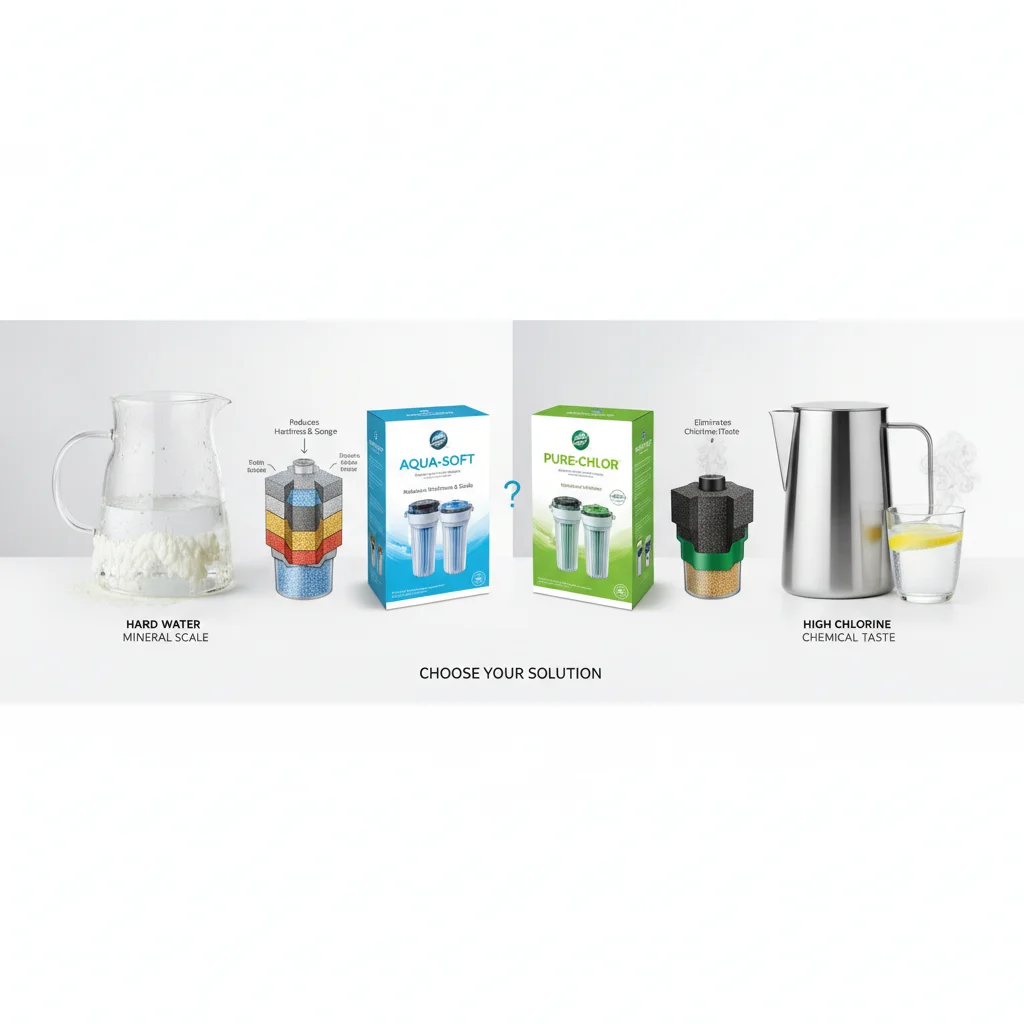
Shoppers hunting for the best water filter for hard water chlorine usually have two complaints at once: chalky kettles and pool-like tap smell. Those problems share a faucet, but they punish cartridges differently, so a “taste winner” can still die early on mineral load.
Hard water is mostly dissolved calcium and magnesium. It leaves white rings, slows flow as fines pack media, and shortens the useful life of thin pitcher cartridges. High chlorine (or chloramine in some cities) is a disinfection residual that activated carbon handles well—until capacity is spent and taste drifts back.
This guide is for apartments and houses that want better drinking and cooking water without a whole-house softener. It is not medical advice, and a countertop filter is not a cure for a boil-water notice or a documented lead crisis. Use it to pick capacity and media that match your utility chemistry.
- Chlorine-first homes: prioritize carbon capacity and certified taste/odor reduction
- Hardness-first homes: prioritize larger cartridges, sediment/prefilter stages, and honest replacement intervals
- Both at once: buy for the clogging risk, then confirm the carbon stage still kills chlorine taste
- Renters: stay with no-install pitchers or countertop dispensers
What hard water minerals do to filter cartridges
Mineral-rich water does not “break” plastic housings overnight. It packs pores, coats mesh, and forces the system to push harder for the same pour. Flow drops first; then people skip the filter because waiting feels annoying.
Pitchers with dense, short carbon beds clog fastest when kettles scale weekly. Larger countertop housings often include a coarser first stage that sacrifices some speed to protect the main media. That protection only helps if you clean reservoirs and change cartridges on real gallon use.
Hard water minerals and high chlorine are separate tap problems: carbon fixes taste fast, but mineral load usually decides how soon a cartridge clogs. Keep that split in mind when a review ranks “best taste” without mentioning hardness.
Why chlorine taste is easier to fix than scale buildup
Chlorine taste responds quickly to fresh activated carbon. Many households notice a cleaner pour within the first tank. Hardness is slower and more mechanical: minerals keep arriving every gallon, so clogging is cumulative rather than a one-time odor fix.
That is why a cheap pitcher can feel like a miracle for two weeks on city chlorine, then crawl on hard water by month three. Taste success does not prove long cartridge life.
- Confirm whether your main complaint is smell/taste or scale/clogging.
- Check your utility Consumer Confidence Report for disinfectant residual and hardness notes.
- Estimate daily filtered liters for drinking plus pasta water and coffee.
- Size cartridge capacity to that volume before you chase brand prestige.
How to identify your primary water issue
If glasses smell like a pool after sitting overnight, chlorine (or chloramine) is front-of-mind. If shower doors and tea kettles crust quickly, hardness dominates. Many city apartments have both: chlorinated supply plus moderate-to-high hardness.
A simple home hardness strip and a nose check get you most of the way. If you also worry about PFAS or lead, treat those as separate specs—see our best water filter for PFAS notes—rather than assuming a chlorine pitcher covers every claim on the box.
Filters We Tested on Hard Water and High-Chlorine Supplies
We rotated Brita-class pitchers, Clearly Filtered-class premium pitcher media, and Aquasana/Waterdrop-class countertop systems on municipal taps that smelled of chlorine and left visible kettle scale. The goal was practical: taste improvement, fill time, and how fast cartridges felt “done” under mineral load.
Results are decision support, not a certified lab report for your address. Local hardness, sediment events, and chloramine vs free chlorine change timelines. Still, the pattern repeats: carbon wins taste early; capacity and prefiltration win longevity.
Test locations and baseline water quality
Baseline taps showed strong chlorine odor at the kitchen faucet and white scale on electric kettles within a week of normal use. We filtered drinking and cooking water for small households (roughly 0.75–1.5 gallons per person per day) and logged fill times plus blind taste notes.
We did not pretend a pitcher replaces a softener for whole-home scale. Softeners change plumbing chemistry; these units target pour-by-pour drinking water. If your only goal is spotless fixtures, a point-of-use drinking filter will disappoint.
- Budget pitcher baseline: fast setup, early taste win, earliest slowdown on hard water
- Premium pitcher media: broader claimed contaminant lists, better mid-life taste hold when gallons stay inside rating
- Countertop multi-stage: steadier batch volume, slower clogging when a prefilter stage is present
Countertop dispensers vs pitchers on hard water
Pitchers win fridge space and price. Countertop dispensers win when you refill bottles for a family and hate babysitting a slow gravity pour. On hard water, the dispenser advantage is mostly cartridge volume and optional sediment stages—not magic branding.
For apartments on chlorinated city water with kettle scale, a larger countertop cartridge usually outlasts a thin pitcher when daily volume is high. Light solo use can still be fine with a quality pitcher if you replace early.
Format trade-offs are covered in depth in our pitcher vs countertop vs under-sink filter comparison. Renters who cannot touch plumbing should stay in the no-install lane of the best water filter for apartments and renters guide.
Flow rate and cartridge life under mineral load
Flow is the early warning most people notice. A pitcher that filled in under two minutes stretching toward four is telling you media is packing—even if water still tastes okay for a little longer.
| Filter class | Chlorine taste (weeks 1–3) | Hard-water clogging risk | Best fit |
|---|---|---|---|
| Budget pitcher (Brita-class) | Strong early improvement | High if scale is heavy | Light use, taste-only priority, tight budget |
| Premium pitcher media | Strong, usually longer hold | Medium—still capacity-limited | Broader claims + fridge pitcher habit |
| Countertop multi-stage | Strong batch taste | Lower when prefilter protects media | Families, hard water, higher daily gallons |
Track install date and estimated gallons. Manufacturer “up to six months” stickers assume standardized water, not your kettle’s scale pattern.
Best Filters for High Chlorine Taste (Apartments and City Water)
If your water smells like a pool and scale is mild, optimize for carbon capacity and convenience. You can spend less than a hardness-heavy household because clogging will not dominate as early.
Still replace on usage. Chlorine taste can return weeks before a cartridge is fully “dead,” especially if you push past rated gallons to save money.
Top performers for chlorine reduction
Fresh carbon stages across Brita-class, Clearly Filtered-class, and Aquasana/Waterdrop-class units all improved odor quickly in our rotation. The ranking shifted with time: larger cartridges held the clean taste longer between changes.
Premium pitcher media often justified itself when users wanted broader contaminant claims alongside chlorine control. Budget pitchers remained the value pick for taste-only apartments with modest daily volume.
Brand-by-brand nuance lives in Clearly Filtered vs Brita vs Aquasana vs Waterdrop. For an overall shortlist beyond this hardness/chlorine wedge, start with best countertop water filter 2026.
How fast taste improvement fades
On high-chlorine taps, budget pitchers often showed the first taste drift as fill times slowed—sometimes in the three-to-five-month window for heavy drinkers. Premium media and countertop cartridges stretched that window when gallons stayed honest.
Taste is not a perfect lab proxy, but it is a practical early warning. If coffee suddenly tastes flatly chlorinated again, do not wait for the calendar sticker.
- Rinse reservoirs on a schedule; biofilm can add off-flavors that mimic “spent carbon.”
- Flush new cartridges fully before judging taste.
- Avoid storing damp cartridges unused for weeks.
- After a municipal main break, expect earlier replacement even if the sticker disagrees.
Budget vs premium options for taste-only concerns
Buy budget when hardness is low, household size is small, and you will replace cartridges without resentment. Buy premium or countertop when you also want stronger contaminant coverage, hate frequent shopping trips, or fill multiple bottles a day.
Total cost of ownership matters more than the box price. A cheap pitcher with frequent swaps can rival a pricier cartridge that lasts. Run the math with our water filter replacement costs over 2 years breakdown before locking a brand.
Chlorine taste water filter comparison tip: rank “weeks of clean taste per dollar of cartridge,” not launch-day Amazon stars.
Best Filters When Hard Water Clogs Cartridges Fast
When kettles scale weekly, treat clogging as the primary failure mode. A filter that tastes great for a month and then crawls is a bad hard-water buy—even if chlorine reviews look glowing.
Look for larger media beds, optional sediment/prefilter stages, and housings you can clean without tools. Expect to replace earlier than marketing months suggest.
Which models survived hard water longest
Countertop multi-stage units generally kept usable flow longer than thin budget pitchers on the same hard supply. Premium pitcher media sat in the middle: better than the cheapest cartridges, still limited by gravity-pitcher geometry.
Survival here means “still pourable and tasting acceptable inside a realistic gallon budget,” not “never needs service.” Clean lids, spigots, and reservoirs when you change cartridges so you do not blame media for a hygiene problem.
- Prefer larger cartridges if two or more people drink filtered water daily.
- Favor designs with a clear prefilter or sediment stage when turbidity or scale is obvious.
- Descale reservoirs if chalky rings appear.
- Replace cracked O-rings instead of overtightening housings.
Pre-filter or descaling workarounds
Some households add a simple sediment prefilter ahead of a countertop inlet where the design allows it. Others only rinse and descale the reservoir. Neither turns a drinking filter into a softener, but both can slow the feel of clogging.
Do not pour visibly sandy or rusty water into a fine pitcher cartridge after plumbing work. One dirty week can age media more than a month of clear water.
If scale on fixtures is the real goal, plan a softener or conditioner conversation separately. Point-of-use drinking filters are for the glass, not the water heater.
When a pitcher is enough vs when you need a dispenser
A pitcher is enough for one or two light drinkers on moderate hardness who accept quarterly cartridge swaps. Move to a countertop dispenser when fill times frustrate you, daily gallons are high, or hard water kills pitcher cartridges before you finish a coffee subscription cycle.
Under-sink systems can help homeowners who want hidden hardware, but they are a different install path. This article stays focused on no-drama countertop and pitcher options for hardness-plus-chlorine taps.
Which Filter to Buy Based on Your Local Water Report
Your utility’s Consumer Confidence Report (CCR) is the cheapest research step most buyers skip. It will not list every private-well quirk, but it frames disinfectant residual, hardness commentary, and regulated contaminants worth matching to product claims.
Match your choice to the utility Consumer Confidence Report first—chlorine-only complaints and hardness-driven clogging need different filter priorities. Then confirm the product’s NSF/ANSI markings align with what you actually care about.
Match filter type to your CCR or utility report
High free chlorine or chloramine notes push you toward robust carbon capacity. High hardness or frequent customer complaints about scale push you toward larger cartridges and earlier replacement planning. Lead or PFAS flags require reading the exact certified claims—not assuming “removes chlorine” equals “removes everything.”
| What your report / home shows | Priority | Practical pick |
|---|---|---|
| Strong chlorine smell, little scale | Carbon capacity + easy swaps | Quality pitcher or mid-size countertop |
| Heavy kettle scale, mild odor | Clogging resistance + capacity | Countertop multi-stage; replace early |
| Both smell and heavy scale | Capacity first, taste second | Larger countertop cartridge; log gallons |
| PFAS/lead concerns listed | Certified reduction claims | Premium media with explicit standards |
When to test at home before buying
Home hardness strips and inexpensive TDS meters are imperfect, but they catch “surprise hard water” when the CCR is vague. If you are on a private well, test before you buy—municipal averages will not apply.
Retest after you move, after major plumbing work, or if taste suddenly changes. Water chemistry is allowed to surprise you; your cartridge budget should not.
- Test hardness if kettles scale faster than neighbors claim.
- Trust your nose for chlorine, then confirm with the CCR disinfectant section.
- For health-critical contaminants, use a qualified lab plan rather than taste alone.
Quick decision matrix for renters and homeowners
Renters: pitcher or countertop only; favor models you can pack when you move. Homeowners: same starting point unless you are ready for under-sink or whole-house projects.
If hardness and chlorine both bother you and you cook with filtered water daily, buy the larger cartridge even if the sticker price stings. The expensive failure mode is buying three thin pitchers a year because each one clogged at month two.
Frequently Asked Questions
Can one filter fix both hard water and chlorine taste?
A good carbon stage can clear chlorine taste quickly, but hardness minerals still shorten cartridge life. Expect taste wins and clogging risk to move on different timelines unless you choose higher-capacity media and replace on usage, not calendar stickers alone.
What is the best water filter for hard water in an apartment?
Renters usually do best with a no-install pitcher or countertop dispenser that has larger cartridge capacity. Thin budget pitchers improve taste early but clog sooner when kettles show heavy scale. Avoid under-sink installs if your lease blocks plumbing changes.
Why does my filter clog so fast on hard water?
Dissolved calcium and magnesium leave fines and scale that pack pores and prefilter stages. High daily gallons accelerate that. Clean reservoirs, flush new cartridges correctly, and replace earlier when fill times roughly double.
Is a countertop dispenser better than a pitcher for chlorine?
For chlorine taste alone, both can work if carbon capacity matches your volume. Dispensers usually hold taste longer between changes because the cartridge is larger. Pitchers win on price and fridge space when household use is light.
Should I buy based on my utility water report?
Yes. Use the Consumer Confidence Report for chlorine residual, hardness notes, and any flagged contaminants. If hardness is high and you cook a lot of filtered water, prioritize capacity and clogging resistance over the cheapest pitcher.
Bottom Line
Pick the best water filter for hard water chlorine by separating taste from clogging. Carbon fixes chlorine fast; mineral load decides how long the cartridge stays usable. Size capacity to your gallons, read the utility report, and replace on performance—not optimism.
For most renters with both complaints, a larger countertop cartridge is the safer default. Solo drinkers on milder hardness can stay with a quality pitcher if they accept earlier swaps. Keep claims honest, keep reservoirs clean, and treat day-one taste as the start of the test—not the finish.
Related reading on our sister sites: Best Air Quality Monitor for · Best Smart Lock for Home