If you want the best laundry detergent sheets for cold water, start with how labs define “cold,” not with a jug-free slogan. Consumer Reports washes stained swatches on a normal cycle with cold water, high spin, and a heavy-soil setting. In that protocol, even the strongest thin sheet it named — Earth Breeze — scored 29 overall against 84 for Tide Plus Ultra Stain Release liquid. ENERGY STAR still wants most loads on cold, because heating water uses about 90% of a washer’s energy, unless the stain is oily.
This page sorts dissolve claims from stain scores using Consumer Reports’ cool-water ratings (updated March 31, 2026), Good Housekeeping’s June 2026 sheet panel, ENERGY STAR’s washer tips, Maytag’s 60°F dissolve note, and the dosing pages from Earth Breeze, Hey Sunday, Blueland, and Arm & Hammer. Format comparisons sit on the published hub for laundry detergent sheets in 2026.
Stay on a long cold cycle with an enzyme sheet or strip — Earth Breeze if you buy in a store, Hey Sunday if you will follow its two-strip medium dose, Arm & Hammer Power Sheets if you want the cheaper CR-tied thin sheet — and keep a liquid pretreat for grease. Skip exclusive tap-cold if your inlet water sits below about 60°F, the drum is packed, or you run a 15-minute quick wash. Blueland is a tablet, not a sheet; its own page tells you to step off the coldest setting in winter.
Cold on the dial is not one temperature
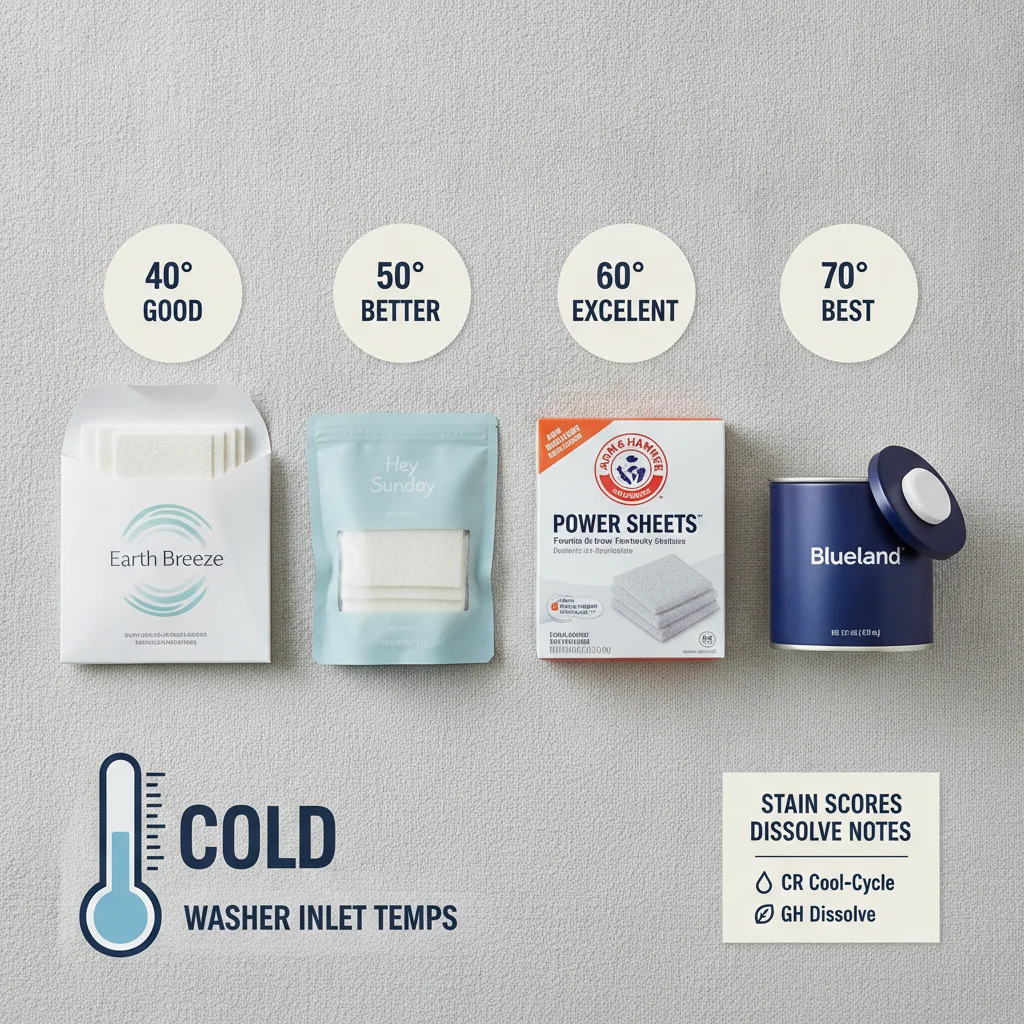
Washer buttons lie by simplification. Hey Sunday’s chemistry note, updated 27 October 2026, puts summer tap cold around 60–75°F and winter tap around 40–60°F depending on pipes and climate. Sodium dodecyl sulfate, a surfactant in many sheets including Hey Sunday’s, has published Krafft points roughly 48–64°F; one common reference sits near 61°F. Below that band some surfactants stop forming the micelles that lift oil.
Maytag’s residue article is blunter: detergents are formulated to clean well above 60°F (15.6°C), and water colder than that does not dissolve detergents well, especially powders. The brand tells you to use liquid when the incoming water is that cold, and to run the nearest hot tap so heated water actually reaches the drum. A sheet is closer to a dry concentrate than to a liquid. If your basement lines are 45°F, the “cold” cycle is a chemistry problem, not a brand loyalty test.
ENERGY STAR’s clothes-washer page is the energy half of the same story. Water heating consumes about 90% of the energy it takes to run a washer. Switching from hot to warm can cut that energy use in half; the cold cycle cuts it further. ENERGY STAR also flags the exception that matches CR’s stain set: oily stains. Cold as a default is the right bill-cutting move. Cold as a religion on a chef’s coat is how people rewash, which spends the energy you thought you saved.
HE drums make “cold” even stingier
High-efficiency machines use less water on purpose. A PVA film or a compressed tablet has to meet that smaller bath, then circulate. Overfilling is the failure mode every brand that publishes a how-to now warns about. Blueland’s June 17, 2026 tablet article says to put the puck in the drum first, leave space, snap it in half on a short cycle, and use the temperature setting up from the coldest, especially in winter. That is tablet physics written in public. A starved cold HE load is the same physics for a sheet.
Hey Sunday’s cold-water page lists the same cluster of misses: too few strips for a packed drum, a quick or hand-wash cycle that never gives the film time, winter tap water, untreated hard water, and chlorine bleach in the same wash as enzymes. None of those are unique to sheets. They hit sheets first because the dose is a discrete strip, not a pour you can nudge.
What stain labs actually wash on
Consumer Reports’ sheet write-up (updated August 24, 2024) is the cold-cycle document people skip when they only read a brand envelope. Engineers stained swatches with blood, body oil, chocolate, coffee, dirt, grass, and salad dressing, then washed on normal, cold, high spin, heavy soil. Sheets as a group scored below CR’s weakest liquids and pods. Earth Breeze was the highest-rated strip in that round at 29 overall. Tru Earth Eco Strips sat at 11. Tide Plus Ultra Stain Release liquid scored 84. CR called Earth Breeze only moderate on dirt and poor on coffee, and said laundry sheets were especially bad on coffee stains.
The March 31, 2026 CR “best and worst detergents” update did not reverse that class verdict. The article states that sheets test so poorly in CR’s labs that the organization does not recommend them. Among standard thin sheets, Arm & Hammer Power Sheets tie Earth Breeze Liquidless Eco Sheets for the top spot and share the same unimpressive overall score. In that write-up, Arm & Hammer cleaned chocolate and blood better than Earth Breeze; Earth Breeze was better on dirt and grass, with a passable but inconsistent dirt rating. Both were less than satisfactory on body oil, salad dressing, and grass. CR says to avoid both for blood and coffee. Tide Evo Free & Gentle fiber tiles topped the broader “sheet” category by a wide margin, and CR is explicit that Evo is not a thin sheet — it is a pad-sized tile that cleans more like an adequate powder.
Good Housekeeping’s Home Care & Cleaning Lab does not use CR’s exact cold/heavy protocol. GH stains cotton swatches, lets them set overnight, and washes an 8-pound mixed load on a normal heavy-soil cycle, following each brand’s dirty-load dose. The June 18, 2026 update made Earth Breeze a Seal Star: strong on chocolate syrup, ketchup, and wine; weaker on mustard and blood. Hey Sunday landed among the better removers of oil, coffee, and beef gravy and held its own on mustard and lipstick. Arm & Hammer Power Sheets did well on ketchup, chocolate, wine, and gravy. GH also ran a separate Earth Breeze review that used both warm and cold water in front- and top-loaders; stain removal sat in the middle of 24 sheets, good to very good on cola, egg, chocolate, wine, and mascara, and weak on blood, mustard, lipstick, and ink.
Two labs, two questions
CR answers “does this formula lift set-in soil on a cool cycle as well as Tide?” The answer for thin sheets is no. GH answers “among sheets, who lifts common food dyes and kitchen grease on a full agitated cycle, and does the film disappear?” Earth Breeze wins GH’s food-dye set. Hey Sunday wins more of GH’s oily set, at a two-strip medium dose. Neither lab published a head-to-head of Earth Breeze, Hey Sunday, Blueland, and a no-name Amazon strip in one washer on a documented 60°F inlet. Treat a Seal Star as a ranking among sheets. Do not read it as “oil on a work shirt is solved at tap-cold.”
GH’s own FAQ is the dissolve result people actually need. Every brand GH tested claims any water temperature. On a tabletop, all but one sheet (EC30, GH’s overall pick) fully dissolved in both warm and cold water. Every sheet, including EC30, fully dissolved in the washing machine after a full cycle with mechanized agitation. Dissolve in a running drum is not the same as a 29 stain score. It is the difference between a gummy film on a black shirt and detergent that at least got into the water.
Dissolve is not the same as clean
Earth Breeze’s product page says the sheets dissolve in hot or cold, work in all temps, and are HE compatible. Dose is half a sheet for a regular load, a full sheet for large, two for heavily soiled or extra-large. GH prices a medium load as a full sheet and got about $0.42 in the June 2026 panel, because the “60 loads” line on a 30-sheet pack assumes half-sheet small loads. That pack-count trick is the same kind of first-number trap as two-year water-filter replacement costs: the envelope math is not the bill if you actually wash medium family loads.
Hey Sunday does not perforate a square. One strip is a small load, two a medium, three a large, plus an extra strip when the load is heavily soiled. GH’s medium-load method used two strips and listed about $0.82, or $15 per 60-strip subscription pack on heysunday.com in that round. The brand’s cold-water article says its strips dissolve in hot or cold, and that a gummy piece after a cold wash usually means the drum was packed too tight for water to reach the film. That is a manufacturer diagnosis, not a lab timer.
Arm & Hammer prints “Quick Dissolve Technology” and “all wash temps, even cold water,” with one sheet for a medium load and two for large or heavily soiled. GH listed about $0.30 per medium load for the scented Power Sheets it tested. CR’s 2026 roundup is why this cheap box matters on a cold-water page: it ties Earth Breeze among thin sheets on CR’s cool-water stain set, and it beat Earth Breeze on chocolate and blood in that write-up. It is still a thin sheet. It is not a Tide liquid.
Blueland’s laundry SKU is a 6-gram tablet with no PVA film. Citing it as a “sheet that failed in cold water” is a category error. The brand’s how-to is the cold-water tell: drum first, do not overstuff, break in half on a short cycle, bump one temperature notch off the coldest in winter. If your rule is “no PVA,” the tablet matches the rule and you follow those dissolve notes. If your rule is “I want a tearable sheet on a long cold cycle,” stop after Earth Breeze, Hey Sunday, and Arm & Hammer.
Which packs to buy if you stay on cold
| Product | Format | What independent tests said on cool or mixed cycles | Cold-water instruction from the brand or a washer maker | Pack math in GH’s June 2026 sheet round |
|---|---|---|---|---|
| Earth Breeze Eco Sheets | PVA sheet, perforated | CR overall 29 on a cold cycle (2024 sheet article); GH Seal Star on chocolate, ketchup, wine; weaker on mustard and blood | Brand: dissolves in hot or cold, any cycle. Maytag: detergents struggle below 60°F inlet water | About $0.42 per medium load at one full sheet; 30 sheets labeled up to 60 half-sheet loads |
| Hey Sunday strips | PVA strip, no tear line | GH: among the better oil, coffee, and gravy removers; not in CR’s named sheet set | Brand (Oct 2026): dissolves in cold; bump to cool/warm if winter tap is dulling clothes; SDS Krafft point near ~61°F | About $0.82 per medium load at two strips; $15 / 60-strip subscription in GH’s check |
| Arm & Hammer Power Sheets | PVA sheet | CR 2026: ties Earth Breeze among thin sheets; better than Earth Breeze on chocolate and blood, worse on dirt and grass | Brand: Quick Dissolve in all temps including cold; 1 sheet medium, 2 large | About $0.30 per medium load in GH’s panel |
| Blueland laundry tablet | No-PVA tablet, not a sheet | Not in GH’s sheet round or CR’s named thin-sheet list | Brand (June 2026): use the setting up from the coldest, especially in winter or on a short cycle | Not priced as a sheet in GH’s sheet table; brand lists ~$0.32–$0.35 / load on refill pages |
If the washer stays on cold and you still want a sheet you can grab at Target, Earth Breeze is the default: GH Seal Star on food dyes, CR’s least-bad named strip in 2024, stores stock it, and the core Fresh Scent and Fragrance Free SKUs are the ones Earth Breeze now says it makes in Kentucky. If oily kitchen stains are the mess you actually have, GH’s oil/gravy result plus Hey Sunday’s two-strip chart is the better match, at roughly double Earth Breeze’s GH medium-load price. If you want the thin sheet CR tied with Earth Breeze for less money, Arm & Hammer Power Sheets are the 2026 CR pick in that band. If you refuse PVA, buy the Blueland tablet and do not run the coldest winter setting.
Generic Amazon marketplace strips are not a fifth lab result. CR already put the sheet class below weak liquids. A no-name 160-count pack is not the product you use to argue with that. Use those packs, if you use them at all, on a long warm cycle with room in the drum. Do not use them as the family detergent for oil, grass, and a tap-cold HE towel load.
What “best” means when CR will not recommend the class
On this page, “best” means the thin sheet that is least wrong for a household that will not go back to a jug, will pretreat grease, and will give the film a full agitated cycle. It does not mean the sheet beat Tide on CR’s cool-water stain set. It did not. If stain removal on coffee, blood, body oil, and salad dressing is the job, CR’s 2026 liquid and pod winners still win, and ENERGY STAR’s oily-stain exception still applies. A sheet plus a small bottle of a strong pretreat is a more honest cold-water kit than a premium envelope used as a stain stick.
How to wash sheets on a cold cycle
Put the sheet in the empty drum, then the clothes. GH, Earth Breeze, Hey Sunday, and Arm & Hammer all put the dose in the drum, not the detergent drawer. A drawer on a cold HE fill can leave a film sitting in a cup that never sees enough water. Dry hands. A wet hand starts the PVA before the cycle does.
Dose for the drum you actually filled. Earth Breeze’s half-sheet line is a small load. GH’s medium load was a full Earth Breeze sheet and two Hey Sunday strips. Underdosing a packed towel load on cold is how people decide “sheets don’t work.” Adding a second cheap strip on top of an already gummy film is how people get residue. If the last wash left flakes, reduce the load, lengthen the cycle, and check inlet temperature before you double the detergent.
Give the film time. Hey Sunday says quick and hand-wash cycles starve dissolve; on a hand-wash cycle it even tells you to tear a strip into pieces and scatter them. GH’s machine dissolve result used a full cleaning cycle with agitation. A 15-minute cold quick wash in a compact front-loader is the opposite of that test. If you only have a short window, a liquid on that short cycle is a cleaner “eco” choice than a premium sheet that never left the fold of a jeans leg.
Pre-treat what CR already marked as weak. CR’s sheet set struggled on coffee, blood, body oil, and salad dressing. GH still says tough stains want a pre-wash spray, and that sheets do not replace that step. Rub a dedicated stain remover, or a drop of dish soap on grease, then run the sheet for the rest of the drum. Earth Breeze’s own CR home write-up suggested supplementing tough stains with a spray such as OxiClean MaxForce. That is not a knock on cold water. It is how you keep the cold cycle instead of rewashing on hot.
Winter tap, hard water, and dingy whites
If clothes look fine in July and dull in January, Hey Sunday’s first check is water temperature, not a new brand. Move one notch to cool or warm. You do not need a sanitize cycle. ENERGY STAR warns that sanitary cycles spend a lot of energy heating water; save that for illness, which ENERGY STAR also notes as a reason some households temporarily switch to hot.
Hard water is a mineral problem, not a sheet problem. Calcium and magnesium bind anionic surfactants. Hey Sunday uses citric acid as a phosphate-free builder and says citrate is a weaker chelator than EDTA or phosphates. A citrate sheet in very hard water will still beat a formula with no builder, and it will not replace a softener. Dingy towels after months of cold HE washes are often leftover hardness plus leftover detergent. Maytag’s extra-rinse advice is the washer-side half of that; a monthly machine clean is the other half.
Do not store sheets in a steamy closet. GH notes they go mushy in humidity and that some brands print expiration dates. A damp envelope is a dissolve failure you caused before the washer ran.
When a warm bump is the honest move
ENERGY STAR: unless you are dealing with oily stains, cold will generally do a good job. The inverse is the rule for this page. Cooking oil, salad dressing, body oil, and grease-heavy work clothes are the loads where a sheet on tap-cold is most likely to leave soil CR already scored as less than satisfactory. Pretreat, then use warm, or keep a strong liquid for those loads only.
Protein stains are the other miss. Blood and mustard were weak spots on GH’s Earth Breeze swatches. CR says to avoid Earth Breeze and Arm & Hammer Power Sheets for blood and coffee. Cold water can set some protein stains. A sheet that already underperforms on blood is the wrong tool for a cold soak you then dry on high heat.
Inlet water below 60°F is Maytag’s line, not a marketing slogan. If you live where winter mains are that cold, run the nearby hot tap so the first gallons into the drum are not pipe-cold, or select cool. Blueland already baked that bump into its tablet directions. Pretending a PVA film is exempt because the envelope says “all temps” is how you get a sticky cuff and a second wash.
Rewash math matters more than sheet vs liquid branding. A failed cold load spends the water, the electricity, and a second dose. ENERGY STAR’s 90% heating figure only helps if the clothes come clean the first time. A mediocre sheet on an honest long cold cycle, plus a pretreat for grease, still beats a “perfect” eco envelope used as a shortcut on a packed quick wash.
Short map: Earth Breeze for store-bought sheets on a full cold cycle with food-dye stains; Hey Sunday if you will subscribe and follow the oily-load strip chart; Arm & Hammer Power Sheets if CR’s thin-sheet tie and GH’s $0.30 medium load are the budget; Blueland only as a tablet with a winter temperature bump; a jug of a strong liquid still belongs next to any of them for oil and coffee. Cold water is the energy win. The sheet is just the dose.
Frequently Asked Questions
Do laundry detergent sheets work in cold water?
They dissolve on a full agitated cycle in Good Housekeeping’s machine test, and brands state any temperature. Consumer Reports still scores thin sheets far below liquids and pods on a cold stain set. Everyday cotton on a long cold cycle can look fine. Coffee, blood, body oil, and grease usually need a pretreat or a warmer wash.
Which laundry detergent sheets are best if I wash only in cold water?
Earth Breeze is the default store sheet: GH Seal Star on food stains and CR’s strongest named thin sheet in the 2024 cold-cycle article. Hey Sunday if GH’s oil and gravy scores matter and you will use two strips on a medium load. Arm & Hammer Power Sheets if you want the cheaper CR-tied thin sheet. None of them match CR’s top liquids on cool water.
Why do sheets leave a film after a cold wash?
The film never met enough water, time, or heat. Packed HE drums, detergent drawers, quick cycles, and winter inlet water below about 60°F are the usual causes in brand and washer-maker notes. Put the sheet in the empty drum, leave room to tumble, and lengthen the cycle before you add another strip.
Does washing sheets in cold water actually save energy?
Yes, when the load comes clean once. ENERGY STAR says water heating is about 90% of washer energy, and cold cuts more than switching hot to warm. A rewash or a sanitary cycle spends that saving. Use cold for everyday soil; pretreat or warm up for oily stains, which ENERGY STAR calls out as the exception.
Should I switch to warm water for oily stains even with premium sheets?
Yes if pretreat is not enough. CR rated thin sheets less than satisfactory on body oil and salad dressing. ENERGY STAR’s oily-stain exception is the same advice in energy language. Keep the sheet for the rest of the week’s cold loads; do not pretend a Seal Star deleted grease chemistry.