Why sticker price is only half the story
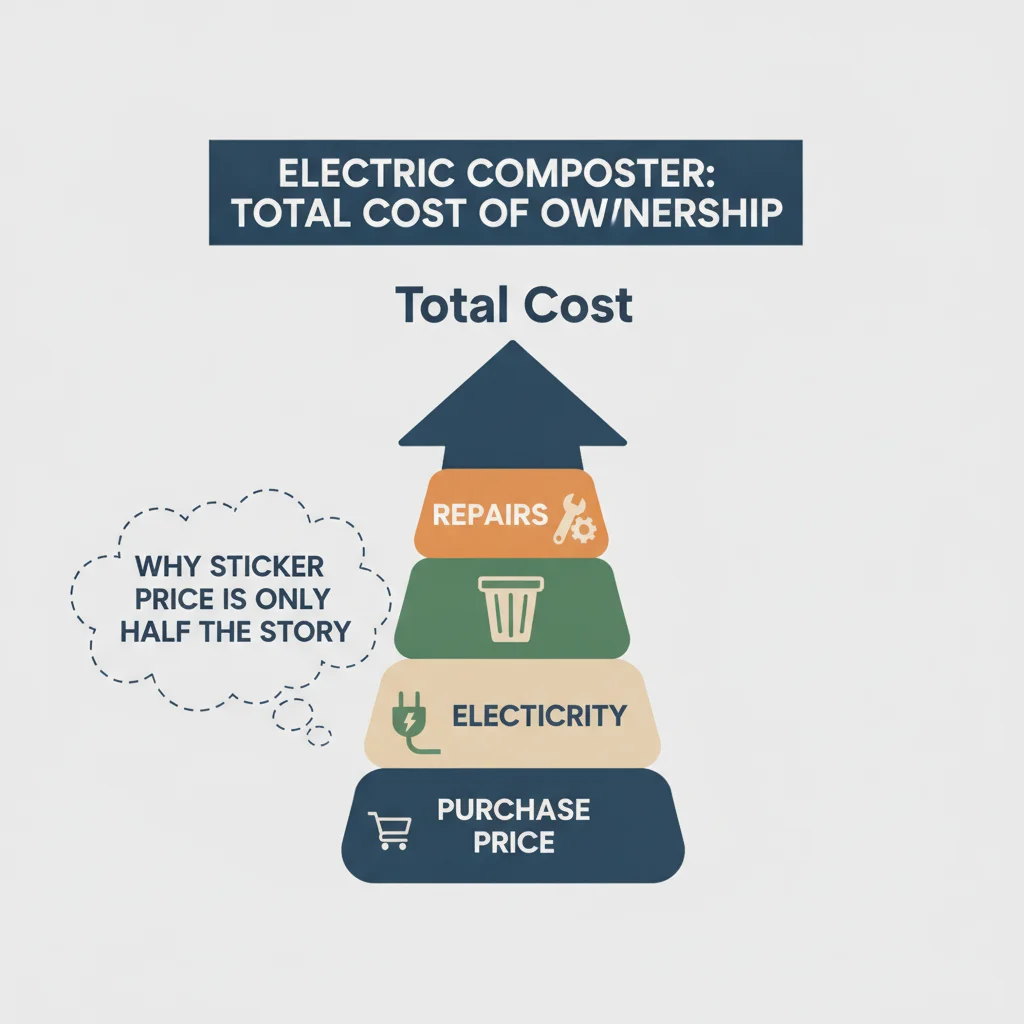
Shoppers comparing Lomi, Reencle, FoodCycler, Mill, and GEME almost always start with the box price. The smarter question is electric composter total cost of ownership after a year or two of daily kitchen scraps—filters, electricity, pods, and the repair bill nobody puts on the product page.
Most machines land between $300 and $700 at purchase. That number feels decisive in a cart. It is not decisive in a real kitchen. After 12–24 months of daily use, recurring parts and the occasional out-of-warranty fix often add another $100–$400 depending on brand, household size, and whether you keep a subscription active.
We tracked receipts, filter orders, and utility estimates across households running grind-and-dry systems and microbial units side by side. The pattern is consistent: marketing sells the appliance; ownership is a small subscription to charcoal, microbes, or pickup logistics you did not fully price in. If you want performance rankings first, start with our best electric kitchen composters we tested; this guide is only about money over time.
- Upfront price is the easy line item; filters and repairs are the ones that surprise people
- Daily electricity is real but usually smaller than consumables
- Subscription models can invert “premium vs budget” within two years
- Household size and cycle frequency change annual spend more than brand loyalty does
Budget $80–$200 per year in filters and consumables for most grind-and-dry systems—not just the purchase price.
That single planning number prevents most buyer’s remorse. Treat the machine like a small appliance with consumables—closer to a coffee maker with pods than to a one-time blender—and the spreadsheet suddenly makes sense.
Electricity and daily cycle costs
Electric kitchen composters heat, grind, aerate, or run microbes for hours. Energy use is visible on a kill-a-watt meter, but it rarely dominates the annual bill. At typical U.S. residential rates around $0.14–$0.18/kWh, most daily cycles land in a narrow band.
What we measured per cycle
- Compact grind-and-dry units (FoodCycler-class): roughly 0.6–1.0 kWh per full cycle
- Mid-size Lomi-style modes: about 0.8–1.5 kWh depending on Eco vs longer modes
- Larger family units and continuous dehydrators: 1.0–2.0+ kWh on heavy loads
- Microbial systems with heaters/fans: often lower peak draw but longer runtime windows
If you run one full cycle most days, annual electricity usually falls between $15 and $45 for compact machines and $30–$70 for larger daily-duty units. That is real money, but it is not the category that makes people email support in month fourteen.
Electricity is usually the smallest line item; filter replacement and out-of-warranty repairs drive most surprise costs. Raise rates to $0.25/kWh in a high-cost utility territory and the annual electricity line can double—still often less than a year’s charcoal filter packs.
Grind-and-dry vs microbial energy profiles
Grind-and-dry systems concentrate energy into a discrete cycle: heat + grind + dry. You see a clear kWh number when the lid unlocks. Microbial composters spread energy across longer retention, aeration, or gentle heat. Owners sometimes assume “true compost” machines are always cheaper to run. In practice, both families can land in a similar annual band if you process similar scrap volume.
The bigger energy variable is behavior: running half-empty cycles twice a day wastes money. Batching scraps into fuller loads usually cuts annual kWh more than switching brands. Apartment kitchens that hide the unit in a closet also care about heat dump and fan runtime—those comfort factors show up in our best kitchen composters for apartments guide, but they also nudge how often people start a cycle.
| Usage pattern | Approx. annual kWh | Cost at $0.16/kWh | Notes |
|---|---|---|---|
| 4–5 cycles/week, compact unit | 180–260 | $29–$42 | Common couple/small household |
| Daily cycle, mid-size grind-and-dry | 300–450 | $48–$72 | Family of 3–4 with frequent cooking |
| Heavy daily + long modes | 450–650+ | $72–$104+ | Large loads, bones/dairy modes, or oversized buckets |
Use the table as a planning band, not a lab certificate. Mode choice, scrap moisture, and ambient kitchen temperature all move the needle. Still, if your TCO model assumes electricity is half the ownership cost, rewrite the model.
Filter, pod, and consumable replacement schedules
Consumables are where ownership math gets honest. Charcoal filters, LomiPods, Reencle filter sets, FoodCycler carbon packs, Mill service fees, and microbial top-ups all exist because odor control and processing chemistry are not free.
Lomi pods and charcoal filters
Lomi owners typically replace charcoal filters every 1–3 months with daily use. LomiPods add another recurring SKU if you run modes that require them. Households that stay on lighter Eco-style cycles spend less; households chasing faster “Grow” results spend more. A realistic Lomi operating cost per year for filters and pods often lands near $100–$180 depending on cadence and whether you buy multipacks on sale.
Reencle and FoodCycler filter costs
Reencle filter price and replacement intervals vary by model and odor sensitivity in the home. Many owners budget for filter changes a few times per year; apartments with open kitchens sometimes change earlier because neighbors notice faint sweet or sour notes before the manufacturer’s “ideal” interval. FoodCycler filter packs are smaller-ticket individually but add up when you run the machine nearly every day. Plan $60–$150/year for most grind-and-dry filter habits unless you stretch intervals aggressively.
- Buy multipacks when the per-filter price drops—shipping fees punish one-off orders
- Do not stretch a dead charcoal filter to “save money”; odor complaints and door-open avoidance cost more in abandoned use
- Track the calendar: most people forget until the kitchen smells remind them
Mill subscription and GEME consumables
Mill’s value proposition often includes bucket logistics or related service. That is not a filter in the charcoal sense—it is a recurring operational fee. Machines with subscription models can exceed the upfront price within 18–24 months if you do not factor recurring fees. If you keep Mill without the pickup path, your TCO looks different than marketing scenarios that assume continuous service. Read the fine print against your actual scrap volume before you call Mill “cheaper long-term.”
GEME-style microbial systems shift spend toward microbes, media, or maintenance kits rather than monthly charcoal. Annual consumable spend can be moderate if the colony stays healthy—and spiky if you crash the biology with oils, cleaners, or long neglect. Budget a contingency line even when the brochure says “low maintenance.”
For technology differences that drive these consumable paths, see our Lomi vs Reencle vs FoodCycler vs GEME comparison. For Mill’s lived reality after a year, the Mill Food Recycler 12-month review is the better companion read.
Repair, motor failure, and warranty reality
Filters are predictable. Motors, lids, sensors, and heaters are not. The ownership cliff appears when something fails just after warranty—or when a “minor” part requires shipping a 30-pound appliance.
Common failure points after 6–18 months
- Grind chamber wear and jammed blades after bones, pits, or fibrous stalks
- Lid latches and seals that stop locking cleanly (cycles abort; odor rises)
- Fan or heater faults that extend dry times or trip error codes
- Control boards and sensors that misread temperature or lid state
- Bucket seals and scrapers that leak residue into places you did not plan to scrub
Heavy meat-and-bone households stress grind mechanisms sooner. If that is your waste profile, pair this TCO view with our guide to electric composters that handle meat, bones, and dairy—capability and repair risk travel together.
Out-of-warranty repair quotes
Quotes we saw and owner reports cluster in ugly ranges: $120–$250 for parts-and-labor on mid repairs, and “replace the unit” advice when shipping plus board cost approaches half the original price. Extended warranties sometimes pay for themselves exactly once. They are not free money if the machine never fails—but a single heater replacement at month 16 can erase the savings from choosing a cheaper model.
| Failure type | Typical timing | Owner options | Budget impact |
|---|---|---|---|
| Filter/odor only | Ongoing | Consumables | $60–$200/year |
| Latch / seal | 8–18 months | Part kit or support ticket | $40–$150 |
| Motor / grind assembly | 12–24 months under heavy use | Repair vs replace | $150–$400+ or new unit |
| Control board | Anytime | Often replace-oriented | High relative to unit price |
Warranty length matters more than brochure tone. Two years of coverage on a family-duty machine is worth more than a flashy feature you will not use. Keep proof of purchase and note the first cycle date; support chatbots are not archival systems.
Extended warranty is worth it when: you run daily heavy loads, you process bones regularly, or the machine sits in a rental where replacement logistics are painful. Skip it when you run light Eco cycles a few times weekly and already budget for a replacement in year three.
Total cost of ownership by model (12–24 month data)
Below is a planning model, not a receipt from one lab. Purchase prices float with sales; consumable pricing changes; electricity rates vary. The point is relative shape: what you pay after the honeymoon.
| Model family | Typical purchase | 12-month consumables + power | 24-month all-in (no major repair) | Watch-outs |
|---|---|---|---|---|
| Lomi 3-class | $400–$600 | $120–$220 | $640–$1,000+ | Pods + charcoal cadence |
| Reencle Prime-class | $400–$700 | $90–$180 | $580–$1,000+ | Filter timing in apartments |
| FoodCycler Eco 3-class | $300–$500 | $80–$160 | $460–$800+ | Smaller capacity → more cycles |
| Mill (with service path) | $500–$1,000+ | $150–$400+ | Can surpass sticker via fees | Subscription assumptions |
| GEME Terra-class | $500–$900 | $70–$180 | $640–$1,200+ | Biology crashes cost time/money |
FoodCycler’s lower sticker can still lose on TCO if you run extra cycles because the bucket is small for your household. Lomi’s higher consumable line is predictable; Mill’s is scenario-dependent. GEME can look efficient until you rebuild a colony after a kitchen disaster involving bleach, citrus overdose, or months of vacation neglect.
Output quality also changes whether “ownership” feels worth it. Dehydrated soil amendment is not the same as garden-ready compost. If you bought the machine to feed raised beds, price the extra curing step—or read our guide to electric composter output for garden soil before you call the TCO a success.
Family vs couple scenarios
- Couple, light cooking: compact grind-and-dry often wins on TCO if filters are stretched sanely
- Family of four with bones and dairy: larger capacity reduces cycle count; repair risk rises
- Apartment with odor sensitivity: you may replace filters early—budget the upper consumable band
- Subscription-tolerant households: Mill can feel convenient; non-subscribers must model fees at zero
Odor and noise do not appear as line items, but they change effective cost when people stop using the machine and leave it as a $500 counter ornament. Real-home odor notes live in our kitchen composter odor and noise apartment guide.
How to budget before you buy
Build a one-page ownership budget before you click buy. Use three lines: purchase, annual consumables, and a repair reserve.
- Purchase: street price after tax and shipping
- Annual consumables: start at $100 mid-band; raise to $180+ for pod-heavy or subscription paths
- Electricity: $20–$60 unless you are a heavy daily user in a high-rate territory
- Repair reserve: $75–$150/year averaged across two years (self-insurance)
Monthly cost estimates by household size (planning only):
- 1–2 people: about $8–$18/month after purchase amortization over 24 months
- 3–4 people: about $12–$28/month with more filters and cycles
- Subscription-inclusive Mill-style path: model the fee explicitly; it can dominate
When cheaper machines cost more long-term: tiny buckets that force two cycles a day, proprietary filters with no multipack discount, and short warranties on motors that grind bones weekly. A $100 cheaper purchase evaporates after one board replacement or eighteen months of premium pods.
If you are still choosing a machine rather than pricing one you already want, return to performance testing and apartment constraints first—then come back here with a shortlist of two. Ownership math is a tie-breaker, not a substitute for “does this handle my scraps without making the hallway smell?”
Frequently Asked Questions
How much does an electric kitchen composter cost to run per year?
Most grind-and-dry machines cost about $80–$200 per year in filters and consumables, plus roughly $15–$45 in electricity for daily cycles at typical U.S. rates. Subscription models can push recurring spend higher if you keep the plan active.
Is electricity the biggest ongoing cost?
No. Electricity is usually the smallest line item. Filter replacement and out-of-warranty repairs drive most surprise costs after the first year.
How often do Lomi filters and pods need replacing?
Expect charcoal filters every 1–3 months with daily use, and LomiPods on the schedule your mode requires. Households that run Grow or similar modes more often spend more on pods than Light/Eco-only users.
Does a Mill Food Recycler subscription change total cost of ownership?
Yes. Mill’s bucket-pickup or related service fees can exceed the sticker price within 18–24 months if you treat the subscription as mandatory. Factor that recurring fee before comparing Mill to non-subscription machines.
When does a cheaper electric composter cost more long-term?
When filter kits are pricey, cycles are energy-heavy, or motors fail just outside warranty. A $100–$200 cheaper purchase can lose that advantage after one repair quote or two years of premium filter packs.
Bottom line
Price the year, not the box. If you only remember three lines: budget $80–$200 yearly for filters on most grind-and-dry systems, treat electricity as a smaller line, and model subscription fees before you declare a winner. That is the practical reading of electric kitchen composter ownership in 2026—and the difference between a useful appliance and an expensive regret.
Related reading on our sister sites: Eight Sleep Pod After Months: · Motorized Window Shades Installation Cost