Shoppers searching ceramic cookware heavy metal leaching safety are rarely asking whether a brand-new, unused pan can pass a lab extract. They are asking what happens after 12–24 months of eggs, tomato sauce, metal tongs, and a dishwasher that the box called “safe.”
Most ceramic skillets are a thin sol-gel coating on aluminum, not a solid ceramic pot—chip maps matter more than the word ceramic on the box. This is a wear-and-replacement guide, not a medical or toxicology opinion. If you have a clinician-directed restriction on metals in food, treat this as kitchen practice and follow that advice.
We already compared family-oriented ceramic sets in our best ceramic cookware for families roundup and tracked coating life in the 12-month non-toxic cookware test. This page isolates the leaching question after the pretty white surface starts to fail.
What “ceramic” cookware actually is
On Amazon and in big-box aisles, “ceramic” almost always means a silica-based nonstick film sprayed or rolled onto a metal body. It is marketed as PTFE-free and often PFAS-free. It is not the same object as a stoneware baking dish or a porcelain-enamel Dutch oven.
That distinction drives the safety story. You are trusting a coating a fraction of a millimeter thick. When it is intact, food mostly contacts the film. When it is not, food contacts whatever the factory bonded underneath.
Sol-gel coating versus solid ceramic
Sol-gel “thermo-ceramic” films start as a liquid, cure in an oven, and form a hard, glassy network. They can be excellent for low-oil eggs on week one. They are brittle compared with seasoned iron and they do not “season back” after you scrape them.
Solid ceramic or enamel-on-iron is a different failure mode: chips of glass-like enamel, not a disappearing gray sheen on aluminum. Do not mix those product classes when you read a leaching headline. The lab method, the substrate, and the replacement rule all change.
- Coated aluminum skillet: watch for gray or black metal showing through the cooking zone.
- Enamel-on-cast-iron: watch for sharp enamel chips and exposed iron that rusts in the chip crater.
- True ceramic bakeware: watch glaze crazing and unknown imported glazes, not nonstick spray films.
What sits under the white or gray layer
The common sandwich is aluminum for heat, sometimes a thin stainless disk for induction, and the ceramic-looking film on top. Some lines add a dark hard-base or speckled “titanium-reinforced” layer. Those words describe hardness marketing, not a lifetime seal.
Aluminum is not a poison label by itself in cookware. The practical issue is a scratched, overheated, acidic-food surface that was never designed to be the cooking face. Once you see substrate, you have changed the product you bought.
PFAS-free is not a leaching exemption
Families switch to ceramic to get off PTFE. That is a real chemistry change. It does not freeze the pan in its day-one state. Unused-ware heavy-metal limits are not the same as a 24-month home cycle with metal spatulas, broiler bursts, and dishwasher detergent.
A PFAS-free badge also says nothing about whether the coating still covers the rivets after you have flipped grilled cheese with a fork. Treat “non-toxic” as a claim about the intended surface, not about a ruined one.
How leaching tests differ from kitchen wear
Regulatory and brand tests usually start with intact cookware, a defined food simulant (often acid), a temperature, and a contact time. That is useful for catching a grossly contaminated glaze or a sloppy factory. It is a weak model of your Tuesday chili in a pan you preheated empty.
Home wear adds abrasion, thermal shock, and detergent. Those are how coatings craze, dull, and lift at the rim long before a lab coupon from the same SKU would fail a first-use extract.
What labs usually measure
Typical extractable-metal screens look at lead, cadmium, and sometimes a longer list (arsenic, cobalt, nickel, aluminum) depending on the standard and the lab package. Results are reported against a limit for that protocol, not against “safe for my toddler forever.”
Brand “tested for heavy metals” slides in a listing are often first-article or lot tests. Ask whether the test was on the coated cooking surface, on a broken edge, or on a decorative exterior. Exterior paint and interior film are not the same sample.
Acid, heat, and repeat-use gaps
Tomato, wine, vinegar, and lemon move metals more readily than plain water. High heat above the coating’s comfort zone (often well below a stainless sear) degrades the film before you see a dramatic flake. Repeat cycles matter more than a single boil-out.
If you simmer marinara for 45 minutes in a pan that already shows silver specks, you are running a home experiment the marketing PDF did not include. Move acidic long cooks to stainless or enamel-lined iron. Keep the ceramic pan for eggs and toasted sandwiches while the film is still continuous.
Prop 65 and import paperwork are not a 2-year warranty
A California warning, or the absence of one, is not a durability spec. Import certificates speak to a shipment, not to your dishwasher. Treat paperwork as a floor for buying new, not as proof the coating will still be the food-contact surface in month 20.
Once the dark or speckled substrate shows through, treat the pan as retired for acidic sauces even if it still looks mostly coated.
What actually happens after 1–2 years
In real kitchens, ceramic films usually fail in this order: lost slickness, staining that will not come off, a dull “sanded” look, then flecks and chips in the high-contact zone. Some pans skip straight to rim chips if they were banged in a sink.
Two years is a typical decision point for daily-driver skillets used on medium-high with metal tools. Gentle, low-heat, silicone-only pans can look newer. That is use, not magic chemistry.
Metal utensils, high heat, and dishwasher cycles
Metal spatulas do not instantly poison a pan. They do mill the film. If you need a metal tool for searing, you bought the wrong surface—use the high-heat and metal-utensil pan guide and keep ceramic for sticky, lower-heat jobs.
Empty-pan preheat on induction or gas is a classic way to brown or craze a ceramic film in one afternoon. Dishwasher detergent is alkaline and hot; it strips oils you might have called “seasoning” and attacks already-microcracked film. Hand-wash if you care about year two.
| Wear sign | What it usually means | Action |
|---|---|---|
| Eggs start to glue | Film is polished or heat-damaged | Drop heat; more fat; still usable if intact |
| Rainbow or brown stains | Polymerized oil and heat tint | Clean; not an automatic toss |
| Sandpapery dullness | Abrasive wear of the film | Stop metal tools; watch for specks |
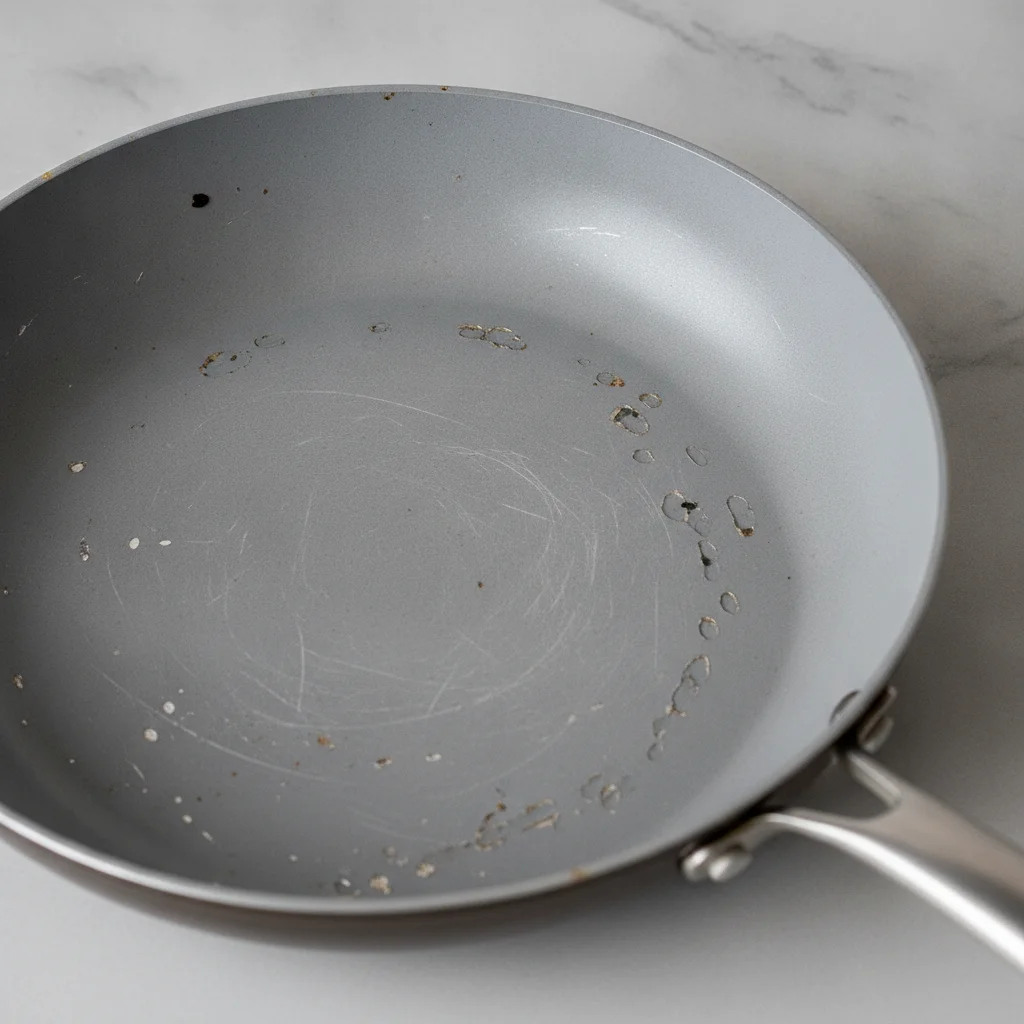
| Silver/gray dots in the cooking zone | Substrate peeking through | Retire for acidic and long cooks; replace soon |
| Flakes in food or on the sponge | Coating delamination | Stop using as cookware |
Hot spots, staining, and “it still looks fine”
Thin aluminum ceramic skillets hotspot. The center film dies first. Owners photograph the rim and swear the pan is perfect while the egg ring is already metallic. Inspect under raking light, dry, after a wash.
“Looks fine” is a lighting problem. Run a fingernail lightly across the center (clean pan, no food). Catching grit is a wear map, not a vibe.
When chips change the safety question
A chip at the exterior rim from rack storage is ugly and can cut a sponge. A chip in the cooking zone is a new food-contact material. That is the moment leaching talk becomes practical instead of theoretical.
Do not grind remaining film with a powdered cleanser to “even it out.” You will only enlarge the bare patch. Replace the pan and move the cooking job to a surface meant to be scraped.
A practical replacement and cooking protocol
You do not need a home chemistry kit to run a kitchen. You need a flashlight, honest heat habits, and a replacement trigger written down so you do not cook “one more month” on a flaking center.
If a family member is pregnant or a clinician has flagged metals, be more conservative: any cooking-zone substrate showing is a stop, not a debate. Everyone else can still use the same visual rule; it is simply good cookware hygiene.
Inspect, don’t guess
- Wash and dry the pan. Look at the center, not the pretty wall.
- Note chips, specks, peeling around rivets, and a gray smear that will not clean.
- If the film is continuous, keep using it for eggs and toasties at medium or below.
- If substrate shows, stop acidic and long simmering. Plan a replacement this week, not “when it dies.”
Home lead swabs can flag some old pottery glazes. They are a weak pass/fail for factory sol-gel on aluminum. Do not let a negative swab talk you into keeping a flaking skillet.
What still belongs in a ceramic pan
While the film is intact: omelets, grilled cheese, pancakes, fish fillets, tofu, and quick vegetable sautés with enough fat. Use silicone or wood. Preheat with food or oil, not bone-dry on high.
Skip: ripping-hot steaks, fond-heavy pan sauces you will deglaze with wine for 20 minutes, and anything that needs a metal fish spatula dug under a crust. Those jobs belong on stainless, carbon steel, or iron.
When stainless or iron is the safer daily driver
If your week is sauces, leftovers reheated in the pan, and teenagers scraping, ceramic is a specialty tool. Clad stainless and well-seasoned iron do not hide a disappearing film because there is no film to disappear.
Brand-versus-brand coating drama is covered in our GreenPan vs Caraway vs Our Place test. Use that when you are still shopping. Use this page when the pan you already own is showing metal.
How this compares with other PFAS-free materials
Ceramic wins the “slidey breakfast” argument on day one. Stainless wins the “I will still have a pan in 2031” argument. Cast iron and carbon steel win searing if you will maintain seasoning. None of them are automatically heavy-metal free if you buy a mystery glaze from an unknown shop and boil acid in it.
For factory-coated Western skillets from known lines, the dominant two-year risk is coating loss exposing aluminum, not a secret lead core. For unmarked imported ceramic vessels with bright decoration, glaze quality is a separate, older problem. Do not flatten those stories into one viral sentence.
Family kitchens and kids’ meals
Kids’ food is often tomato-heavy and cooked in a hurry. That is a harsh combo for a thinning ceramic film. Keep one intact ceramic skillet for eggs if you love it, and put pasta sauce in stainless or enamel.
Do not let a child scrape a peeling pan “clean.” Flakes are a reason to stop, not a snack.
Brand claims versus wear maps
Lifetime, forever, and “mineral” language does not bind the coating to your stove. Compare wear maps: where the spatula lives, where the flame or induction ring sits, where the dishwasher rack hits the rim. Those three zones tell you more than a lifestyle photo of blueberries.
If two pans of the same brand age differently, look at heat and tools before you assume a “bad batch.” Heat and abrasion explain most of the split.
Cost of replacing coatings every two years
A $40 ceramic skillet replaced every 18–24 months is not cheaper than a $120 clad stainless skillet you still own in year five. Add the mental load of wondering about chips. If you like ceramic for eggs, budget it as a consumable, like parchment, not as heirloom metal.
The honest non-toxic stack in a busy house is usually: intact ceramic for sticky breakfasts, stainless for sauces and oven jumps, iron or carbon steel for steaks. Retire the ceramic piece on sight of substrate instead of arguing with a comment thread.
Frequently Asked Questions
Does ceramic cookware leach heavy metals?
New, intact ceramic-coated pans from reputable lines are generally sold to meet extractable-metal limits for unused ware. The useful question is ceramic cookware heavy metal leaching safety after chips, high heat, and dishwasher cycles expose the metal substrate. Once the coating is broken, you are no longer cooking on the marketed surface.
Is ceramic cookware safer than Teflon after two years?
PFAS-free ceramic avoids PTFE/PFOA chemistry, which is why many families switch. Safety after two years still depends on coating integrity. A flaking ceramic pan is not automatically “safer” than a worn PTFE pan—you should retire either surface when it is no longer a continuous coating.
Can I put ceramic nonstick in the dishwasher?
Many boxes say dishwasher-safe. Alkaline detergent plus heat is still a common way coatings dull, craze, and lift at the rim. Hand-wash if you want the coating to last; treat dishwasher use as a durability tax, not a safety feature.
When should I throw away a ceramic pan?
Retire it when you can see or feel substrate, when chips collect in the cooking zone, or when food welding requires aggressive scraping. Cosmetic staining alone is not an automatic toss. Exposed metal plus tomato sauce, wine, or vinegar is the combination to stop.
Do home lead kits prove a ceramic pan is safe?
Swab kits can flag some leaded glazes on pottery, but they are a poor stand-in for extractable-metal tests on sol-gel nonstick over aluminum. A negative swab does not certify two-year kitchen wear. Use kits as a screen for suspicious imported ceramic vessels, not as a pass/fail for coated skillets.
Your next step
Dry the pan you actually use, inspect the center under raking light, and write a replacement rule: substrate in the cooking zone means stop acidic cooks and order a stainless or iron daily driver. Keep ceramic only while the film is continuous, and stop asking a two-year-old coating to be a lab coupon.
Related reading on our sister sites: Nest Doorbell After Years: Worth