The best non-toxic cookware for induction is the set that both couples to the coil and still makes sense after the marketing adjectives fall off. Induction only heats a magnetic base; a pretty ceramic skillet with a small aluminum disk will stutter, whistle, or refuse to start.
This is a use-case list, not a medical clearance. “Non-toxic” here means PFAS-free food-contact surfaces you can actually run on a glass cooktop—stainless, iron, carbon steel, and ceramic-coated pans that pass a real magnet test. For 12-month wear across materials, start with the 12-month non-toxic cookware test. For spatulas and ripping heat, use the high-heat and metal-utensil pan guide.
Clad stainless with a full magnetic ply is the default weeknight pick for PFAS-free induction cooking; ceramic coatings still need a proven ferrous plate. Cast iron works immediately on induction but overshoots; carbon steel is faster and lighter if you will actually season it.
1. How induction compatibility actually works
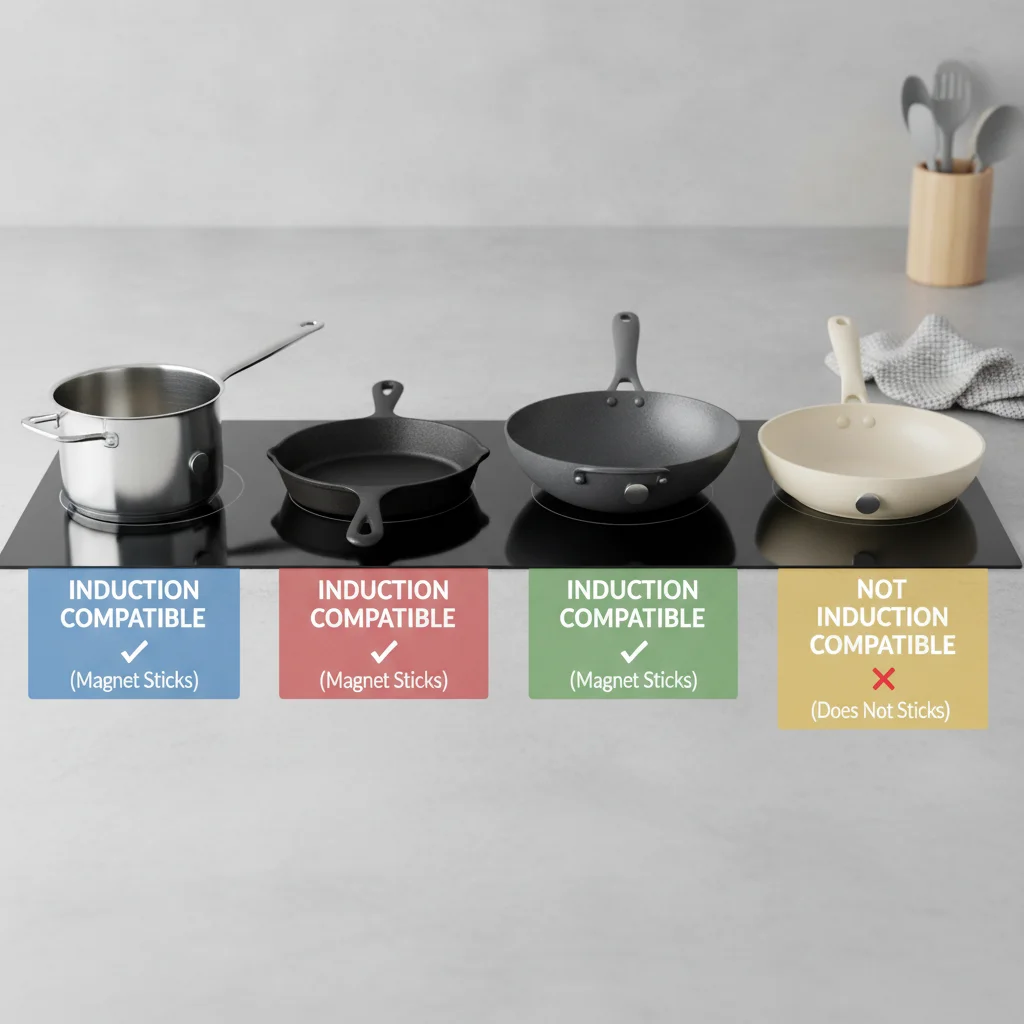
Your cooktop is a coil that wants a ferromagnetic sandwich sitting flat over it. If the magnetic patch is the size of a drink coaster under a 12-inch skillet, the pan hunts, buzzes, or the zone shuts off. Brand names do not override physics.
Compatibility is not the same as “safe chemistry.” A magnetic PTFE skillet can heat beautifully and still be the coating you were trying to leave. A PFAS-free ceramic skillet that will not pair is just a wall decoration.
The magnet test, and what it misses
Stick a fridge magnet to the center of the base, not the handle. Strong grab is a pass for most home zones. A weak slide is a maybe that will annoy you at low simmer. No grab is a no, even if the listing says “induction ready.”
The test misses contact area and flatness. A warped disk can pass a magnet in your hand and still chatter on glass. A tiny steel button in a thick aluminum puck can pass a magnet and still fail on a large zone.
- Pass: magnet holds the pan’s weight at the center of the base.
- Soft maybe: magnet clings but slides off with a nudge—expect fuss at low power.
- Fail: magnet falls. Do not hope the cooktop “learns.”
Disk bases versus full-ply magnetic stacks
Cheap “induction-ready” ceramics and budget stainless often hide a stamped steel disk under aluminum. The disk can delaminate, ring, or leave a cold ring around the edge. Fully clad pans carry magnetic stainless through a larger footprint, so the coil sees a stable load.
If you cook on a portable induction plate with a small coil, even a good 12-inch skillet may only heat the center. Match pan diameter to zone diameter. Oversized decorative rims do not count as magnetic area.
Why “induction-ready” stickers still fail
Stickers are applied to SKUs, not to the warped pan in a closeout bin. They also get copied onto sibling products that share a photo but not a base. Buy the exact product identifier, then magnet-test after unboxing before you peel the rest of the labels.
Retailers bundle ceramic sets that mix one magnetic skillet with two aluminum saucepans. Read every piece. A set is only induction-useful if each pan you will actually use passes.
2. Clad stainless: the default induction pick
For sauces, leftovers, oven finishes, and metal tools, clad stainless is the adult answer. It does not pretend to be nonstick. It does stay chemistry-stable as a food-contact surface when you stop treating coatings as immortal.
Look for a magnetic outer ply or an encapsulated magnetic layer, a thick enough stack that the base stays flat, and rivets you can clean. Mirror-polished interiors look pretty and show every water spot; brushed interiors hide that and still brown food.
Heat-up, fond, and oven jump
Induction drives stainless faster than gas-shy cooks expect. Preheat to the shimmer of oil, not to a screaming empty pan. Fond (the brown bits) is a feature: deglaze with wine or stock. That is how you get sauce without a coating.
Most clad skillets and saucepans are oven-safe to temperatures that ceramic films are not. If you finish chicken under a broiler, stainless belongs in the stack. Confirm handle ratings; phenolic handles are not “the pan.”
What “non-toxic stainless” actually means
Food-grade stainless interiors are an iron-chromium alloy, often with nickel in 18/8 or 18/10. That is normal cookware, not a PFAS story. People with a clinician-directed nickel issue should discuss 18/0 magnetic interiors, not a random “toxin-free” Amazon title.
Stay away from mystery coatings marketed as “ceramic stainless hybrids” unless you can name the coating and accept its wear life. Bare clad is the simple PFAS-free path.
Where stainless still loses to coatings
Eggs and delicate fish want fat, patience, or a different pan. If breakfast is 80% of your induction use, a magnetic ceramic skillet can earn a slot as a consumable. Do not force stainless to be a diner short-order surface and then declare the material a failure.
Stainless also shows heat tint and rainbowing. That is oxide and oil, not proof the pan is leaching. Clean it; do not throw it away because a reel said the colors are “chemicals.”
3. Cast iron and carbon steel on induction
Iron and carbon steel are naturally magnetic. They are the most boringly compatible induction pans you can buy. The work is thermal mass, seasoning, and not grinding grit across the glass.
Cast iron soaks heat and then keeps going after you turn the zone down. Carbon steel is thinner, heats faster, and is easier to lift. Both are PFAS-free if uncoated. Enamel-on-iron is also magnetic; chips of enamel are a different failure than a disappearing spray film.
Overshoot, buzzing, and glass-top scratches
Start one power level lower than your gas habit. Induction plus iron will overshoot and scorch oil. Buzzing often means the pan is slightly concave or the zone is too small; a full-size coil under a skillet quiets most of it.
Lift, do not slide. Sand on the bottom of a campsite skillet will scratch glass. That is a cooktop care issue, not a heavy-metal issue. Keep a dry towel to wipe the base before it goes down.
Seasoning versus marketed ceramic coatings
Seasoning is polymerized oil. It is not a factory ceramic film and it is not immortal if you boil tomato for an hour on week one. It is renewable. That is the whole point versus a sol-gel coating you cannot rebuild.
If you hate maintenance, skip carbon steel and buy clad stainless plus one enamel Dutch oven. If you like ritual, carbon steel on induction is one of the best high-heat, PFAS-free pairings in a home kitchen.
Who should skip heavy iron
Wrist injuries, tiny portable plates, and cabinets that cannot hold a 12-inch skillet are real constraints. A 10-inch carbon steel pan is the compromise. Do not buy a 12-pound grill pan as your only induction tool and then never use it.
Enamel Dutch ovens shine for braises on induction because the glass top is happy with a flat, heavy base. Confirm the lid knob’s temperature limit before you go from simmer to oven.
4. Ceramic-coated and hybrid pans that fail the magnet test
Ceramic-coated aluminum is the category that creates the most induction returns. The cooking surface may be PFAS-free. The base may be theater. Always test the SKU in your hands.
When a ceramic skillet does pass, treat the coating as a 1–2 year breakfast tool, not as the family sauce pan. Heat on induction is abrupt; empty preheats kill films faster than gas users expect.
Aluminum cores with token steel disks
A disk that is smaller than the cooking zone yields a donut of heat and a lot of error beeps. You will think the cooktop is broken. It is the pan. Prefer full-coverage magnetic stainless wraps or a proven induction ceramic line with a wide ferrous plate—not a button.
Hybrid “stainless with ceramic interior” can be excellent if the exterior is truly magnetic clad. It can also be a disk-base aluminum pan wearing a stainless skirt in the photos. Read the spec sheet for induction and for the core metal.
Coating wear on a screaming-hot glass top
Induction will get a light pan past the coating’s comfort zone in seconds. If the film is your non-toxic story, you still have a wear story. Inspect the center after month six. Substrate showing through is a stop for acidic food, the same rule we use in the ceramic leaching guide on this site.
For brand-level coating comparisons, see GreenPan vs Caraway vs Our Place. Only keep the winner if it magnet-tests on your cooktop, not theirs.
When a ceramic skillet is still worth it
Worth it: one magnetic 10-inch skillet for eggs, always with fat, never empty-preheated, hand-washed, replaced when slickness dies or metal shows. Not worth it: an eight-piece ceramic set where half the pieces fail induction and the saucepans are the ones you use for tomato.
If you want one pan that does everything on induction, it will not be ceramic. It will be stainless or iron, and you will use oil.
5. Buying checklist by cooking style
Buy à-la-carte for induction. Sets waste money on non-magnetic extras. Match the zone size you actually have, including that awkward small left burner you use for oatmeal.
| If you mostly cook | First pan to buy | Skip until later |
|---|---|---|
| Eggs, toasted sandwiches | Magnetic ceramic skillet (consumable) or well-preheated stainless with fat | Giant grill pans |
| Sauces, leftovers, oven finishes | 3-ply or 5-ply clad stainless skillet + saucepan | Any non-magnetic aluminum ceramic |
| Steaks, smash burgers | Carbon steel or cast iron that fully covers the zone | Thin disk-base “induction” ceramics |
| Soups and braises | Enamel Dutch oven or heavy stainless pot, flat base | Tall pots with tiny magnetic buttons |
Eggs and weeknight sautés
Weeknights punish coatings. If you sauté onions every night on power boost, buy stainless and accept oil. If eggs are the sacred ritual, isolate that job in one magnetic ceramic pan and do not let teenagers sear smash burgers in it.
Family ceramic shopping without the induction constraint lives in our best ceramic cookware for families guide. Recheck magnet behavior before you duplicate that set on a glass cooktop.
Searing and oven finishes
Preheat stainless or iron on a medium induction step, add oil, then food. Jump to the oven in the same pan if the handle allows. This is where clad and iron earn their keep and ceramic films quietly die.
Do not use broiler mode on a ceramic coating unless the brand states a temperature that you actually believe and you are willing to replace the pan. Stainless is cheaper over three years.
Family sets versus à-la-carte pans
A family of four on induction is usually: 10- or 12-inch clad skillet, 2–3 quart saucepan, stockpot or Dutch oven, plus one iron or carbon-steel searing pan. That is four pieces, not twelve matching lids you never stack.
Color-matched ceramic sets are interior-design. They are only the best non-toxic cookware for induction if every base is magnetic and you have a replacement budget for the coated pieces. Most households are happier if the pretty ceramic is one skillet, not a religion.
Frequently Asked Questions
What is the best non-toxic cookware for induction?
For most kitchens the best non-toxic cookware for induction is fully clad magnetic stainless, with a cast-iron or carbon-steel skillet for searing. Ceramic-coated pans only belong on the list if the whole base is strongly magnetic and you accept a 1–2 year coating life.
Will ceramic cookware work on induction?
Only if the pan has a ferrous base large enough for your cooktop’s coil. Many “ceramic” skillets are aluminum with a small steel disk that hunts, clicks, or never registers. Always do a magnet test on the actual SKU, not the brand name.
Is stainless steel cookware safe on induction?
Magnetic stainless (usually 18/0 outer ply or a dedicated magnetic layer in a clad stack) is the workhorse. Nickel-bearing interiors are normal food-contact stainless; they are not a PFAS issue. Replace pans that warp so the base no longer sits flat on the glass.
Does cast iron scratch induction glass?
Rough cast iron can scuff a glass top if you slide it. Lift, don’t drag, and keep the bottom free of grit. The cooktop risk is cosmetic and thermal-shock related; it is separate from chemical safety.
Why does my pan buzz or shut off on induction?
Usually the magnetic contact patch is too small, the pan is warped, or the coil size does not match the skillet. Lightweight disk-base ceramics are the usual offenders. A heavier clad or iron pan that covers the zone almost always stops the chatter.
Your next step
Magnet-test every pan you plan to use, match diameters to your zones, and buy clad stainless as the default PFAS-free induction set. Add iron or carbon steel for searing, and allow ceramic only as a magnetic, replaceable breakfast skillet—not as the whole kitchen.
Related reading on our sister sites: Best Air Quality Monitor for · Best Smart Lock for Home