If you are weighing detergent sheets vs liquid vs powder, pick the format that matches your stains, washer type, and how you dose, not the one with the loudest packaging claim. Independent lab work still puts powder and liquid ahead of most sheets on stubborn dirt, while sheets win on weight, cardboard packs, and a dose you cannot over-pour.
This comparison draws on CHOICE’s detergent-format tests, Good Housekeeping Institute notes on powder, liquid, pods, and sheets, CPSC guidance on liquid laundry packets, and labeled cost-per-load math from a 27 October 2026 retailer snapshot. It is not a household trial of our own.
Pods sit beside these three as a fourth option. They score well in some front-loader lab lists, cost more per wash than budget liquid, and need child-resistant storage. They are not the default answer for a top-loader or a toddler-height laundry shelf.
Sheets, liquid, and powder at a glance
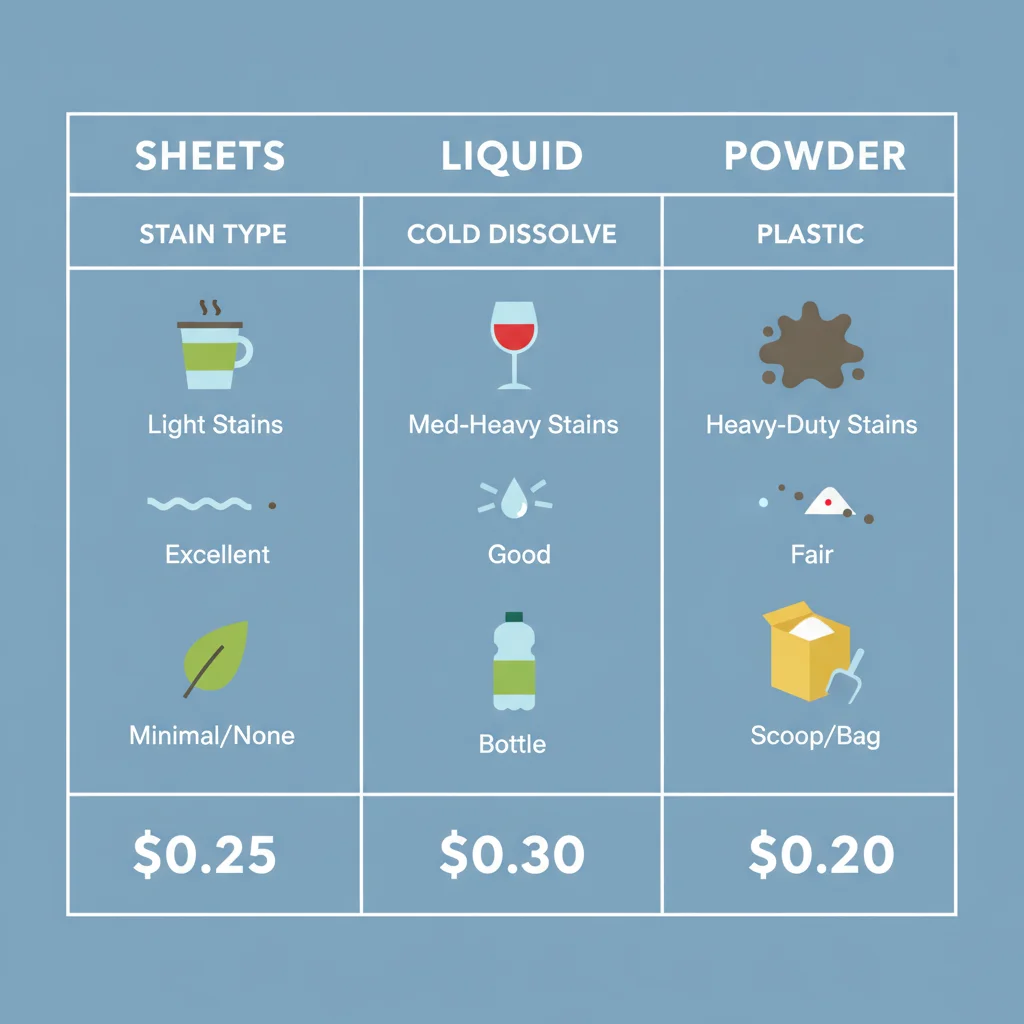
Use this table as a first cut, then read the sections below for the exceptions. “Best” here means best for that job, not best in every washer.
| Job | Usually pick | Why |
|---|---|---|
| Mud, grass, outdoor dirt | Biological powder | GHI stain work still ranks powder first on tough spots |
| Oily food, everyday mixed loads | Liquid (measured to the first cap line) | Easy to pretreat; dose is adjustable |
| Lowest labeled cost per load | Big-jug budget liquid, then powder | October 2026 shelf math puts Xtra-class liquid near 5–9¢ |
| Travel, tiny cupboard, no spills | Sheets | Light cardboard pack; one sheet is one medium load |
| Front loader, want a high lab score and no measuring | Capsules/pods | CHOICE’s recent top scorers were mostly capsules |
| Top loader on a budget | Powder | CHOICE did not recommend capsules for top loaders |
| Toddlers in the house | Powder, liquid, or sheets — not loose pods | CPSC: packets look like candy and dissolve on saliva |
Sheets are a packing and dosing format first. Cleaning still depends on the formula inside the sheet, and most lab scorecards still put powder and liquid ahead on hard stains.
If you already know you want sheets, the brand split (Earth Breeze, Hey Sunday, Blueland, store brands) lives in our Earth Breeze vs Hey Sunday vs Blueland comparison. The buying list for the category is in best laundry detergent sheets 2026.
What each load actually costs
Ignore the bottle price. Divide the shelf price by the load count printed on the pack. That is labeled cost per load. It only holds if you use the dose the brand counted — usually the first line in a liquid cap, or one scoop, or one sheet.
On 27 October 2026, HeySunday published a retailer check (the company sells sheets, so treat the commentary as branded; the table is prices from Walmart, Target, Costco, Sam’s Club, earthbreeze.com, and heysunday.com). A few rows that matter for format choice:
| Format and example | Labeled ¢ / load | Pack math used |
|---|---|---|
| Budget liquid (Xtra 312 fl oz, Walmart) | 5¢ | $13.12 / 260 loads |
| Budget liquid (Arm & Hammer Clean Burst, Target) | 8¢ | $15.99 / 205 loads |
| Powder (Arm & Hammer Plus OxiClean, Target) | 13¢ | $17.39 / 130 loads |
| Sheets (Arm & Hammer Power Sheets, Target) | 13¢ | $13.99 / 104 loads |
| Name-brand liquid (Tide Original, Target) | 20¢ | $24.99 / 126 loads |
| Pods (Tide Pods Original, Target) | 25¢ | $27.49 / 112 loads |
| Subscription sheets (HeySunday 60, site price) | 25¢ | $15.00 / 60 loads |
| Subscription sheets (Earth Breeze 60, site price) | 28¢ | $16.95 / 60 loads |
At 300 washes a year, a 8¢ liquid is about $24 of detergent and a 25¢ sheet is about $75, if both households follow the label. Double the liquid pour and that 8¢ line becomes 16¢, which is how a “cheap jug” can catch a sheet pack. Sheets and pods cannot be over-poured. Powder can be over-scooped just as easily as liquid can be over-poured.
CHOICE’s testers also report that many loads clean as well with about half the stated scoop or cap, which cuts residue in the machine as well as the bill. That trick works for powder and liquid. It does not work for a sealed pod, and it only works for sheets if the sheet is perforated and you actually tear it.
Store-brand sheets (the Arm & Hammer row above) already sit near powder on labeled price. Mail-order eco sheets do not. If the reason you want sheets is plastic, pay the 25–28¢ and stop pretending it is a money-saving swap versus Purex. If the reason is money, buy the biggest jug you will finish before it goes off and fill the cap to the first line.
Cleaning, stains, cold water, and washer type
GHI’s format notes are blunt: in their tests, powders typically outperform other formats on stain removal, especially on tough spots. Biological powder is the format they point at for heavy dirt from kids or outdoor work. Liquid and gel, without bleach, tend to be gentler and easier to use as a spot treatment, at the cost of more machine odor if you under-dose or never run a hot cleaner cycle.
Sheets are newer. GHI finds them less effective than powders and liquids on stubborn dirt, and better on light stains and everyday washes. In a later GHI laundry-sheet roundup, household editor Katie Mortram put the same point in one line: sheets generally do not match liquids on stain removal, but they are fine for ordinary loads, and the gap depends on the brands in the pair. Their UK winner (Must Have Ideas Simple Sheets) did well on cotton and polycotton stain strips. That is a reminder not to treat “sheets” as one formula.
CHOICE’s Australian sheet set was harsher. None of the sheets they tested did well, and Restor Fresh Linen in a top loader scored 44% against 45% for plain water. That is a specific product on a specific protocol, not a sentence you should tattoo on every US mail-order brand. It is still the clearest public lab warning that a cardboard envelope is not a cleaning upgrade by itself.
Cold water and HE machines
Powder that does not dissolve leaves grit in the drum and on dark clothes. That risk rises in short cold cycles. Liquid and most sheets are built to go into the drum or the drawer already dissolved or ready to dissolve. If your default cycle is cold and 30 minutes, powder is the format that needs a second look at the box: “works in cold water” on marketing copy is not the same as “fully gone at 20°C in 15 minutes.”
HE washers use less water, so extra detergent does not rinse. Liquid over-pour shows up as suds and a sour gasket. Powder over-scoop shows up as residue. A sheet is already a medium-load dose; a king-size comforter may want two, and a hand-wash of socks may want a torn half — follow the pack, not a social-media “always one.” For short cold cycles with sheets specifically, see laundry detergent sheets for cold water.
Front loader versus top loader
CHOICE’s latest ranking put four of five top products as capsules in front loaders. In top loaders, they did not recommend a single capsule, and powder took the useful scores. If you own a US top-loader agitator and you were about to switch the whole house to pods “because the lab likes pods,” check which machine that lab used. Format rankings are washer-specific more often than brand blogs admit.
Sheets go in the drum. Do not fold one into a dry HE dispenser and hope. Put the sheet in first, clothes on top, or follow the brand’s diagram. Liquid belongs in the dispenser unless you are pretreating a stain in the drum. Powder belongs in the dispenser on many HE units, or in the drum if the manual says so — a damp dispenser cakes powder into a brick.
Plastic, travel, storage, and child safety
A jug of liquid is mostly water in a bottle. A box of powder is mostly powder in cardboard with a plastic scoop and often a plastic liner. A sheet pack is a stack of dry film in a small carton. GHI’s Katie Mortram’s environmental case for sheets is weight and transit emissions, plus less plastic, not a miracle surfactant. CHOICE makes the same carbon-and-plastic point and still tells readers to skip sheets if cleaning is the goal.
Travel is the unarguable sheet win: no leak in a suitcase, no TSA liquid bag, no clumping box. Tear a week’s worth into a pouch. Liquid is the leak risk. Powder is the humidity risk in a beach rental. Pods travel badly around children and pets because a loose packet on a hotel counter is a poison attractant.
On safety, the CPSC safety alert on single-load liquid laundry packets is the document to follow. Packets look like candy or teething toys. Water, wet hands, and saliva open them. Children have needed hospital care for vomiting, drowsiness, throat swelling, and breathing trouble; eyes have been burned. Keep packets in the original lockable tub, out of sight and reach. If a child swallows one or gets detergent in an eye, call Poison Help at 1-800-222-1222 in the US.
Sheets are not candy-colored gel. They are still detergent. Keep them above toddler height. Liquid jugs with child-resistant caps still spill if a child tips 150 ounces onto a kitchen floor. Powder is dull to eat and still a chemical. None of the three formats is a toy; pods are the format with the documented, colorful, fast-dissolve hazard.
Storage details that actually change the wash:
- Powder in a humid laundry closet clumps. Close the box. Do not store it under a dripping utility sink.
- Liquid that froze in a garage can separate. Stir, then dose; do not assume the first pour is the full formula.
- Sheets in a steamy bathroom can stick. Keep the carton closed, dry hands only.
- Pods in a bag with a split zipper are a recall-class problem. If the tub is cracked, move them.
Who should buy which format
Buy biological powder if you wash sports kits, garden clothes, or muddy kids, you have a dry cupboard, and you will measure a scoop. It is still the stain format GHI points at, and it is still CHOICE’s useful pick for many top loaders. Skip it if every cycle is a cold 20-minute HE wash and you already see white grit on black knits.
Buy liquid if you pretreat collars and cooking oil, want one bottle that can spot-treat and wash, and you can obey the first cap line. Budget liquid is the cheapest labeled load on that October 2026 shelf check. Skip it if you hate plastic jugs, you over-pour every time, or you carry detergent on a bike.
Buy sheets if cupboard space, travel, or cardboard packaging is the actual constraint, and your laundry is mostly everyday cotton, not pitch-stained uniforms. Pay the higher labeled cents unless you find a store-brand sheet near 13¢. Skip them if independent tests of the specific brand you like are poor, or if you need maximum stain lift and will not pretreat.
Buy pods only if you have a front loader, you will store them like medicine, and you will not split a pod for a small load. CHOICE likes them in that narrow window. CPSC still wants them locked up.
A split household is allowed. Keep a small liquid for stains and a sheet box for the weekly cold mixed load. That is not indecision. It is matching chemistry to the pile on the floor.
If your next click is a shopping list rather than a format lecture, start with best laundry detergent sheets 2026 and keep this page for the liquid-and-powder fork.
Frequently Asked Questions
Which laundry detergent format is the best overall?
There is no single winner. GHI stain tests still favor powder on tough dirt and find sheets weaker than powder and liquid on stubborn stains. CHOICE’s recent front-loader list was dominated by capsules, while its top-loader advice pointed at powder. Match the format to washer type, stain load, and whether you will measure a dose.
Are detergent sheets cheaper than liquid or powder?
Usually no, on the label. HeySunday’s 27 October 2026 retailer snapshot put budget liquids around 5–9¢ a load, one Arm & Hammer powder at 13¢, Tide liquid at 20¢, and mail-order sheets around 25–28¢. Store-brand sheets can land near powder. Over-pouring liquid or powder erases the gap; sheets cannot be over-poured.
Is powder detergent outdated?
No. GHI still reports that powders typically outperform other formats on stain removal, especially outdoor dirt. CHOICE still finds good scores and low cost per wash in powders, including in top loaders where capsules disappointed. The live drawbacks are clumping in humidity and incomplete dissolve in short cold cycles.
Do laundry sheets work as well as liquid?
GHI says sheets generally do not match liquids on stain removal and are fine for everyday loads, with brand-to-brand spread. CHOICE’s Australian sheet set scored poorly, including one product that tied or lost to water in a top loader. Treat a sheet as a convenience and packaging choice unless you have a lab score for that exact brand.
Should I switch from liquid to detergent sheets?
Switch if plastic weight, spills, or suitcase leaks are the problem you actually have, and your loads are ordinary. Stay on measured liquid if oily stains, pretreat, and cost per load are the problem. Keep pods out of the decision if young children can reach the laundry shelf; CPSC treats liquid packets as a poisoning hazard.